Effect of movement therapy in individuals with abnormal head posture

S. M. Divya Mary1, S. Bhargavy2

Author:

2BPT Internee, Faculty of physiotherapy, Dr. MGR. Educational and research institute University, Velappanchavadi, Chennai, Tamilnadu, India

Corresponding Author:

1Assistant professor, Faculty of physiotherapy, Dr.MGR Educational and research institute University, Velappanchavadi, Chennai, Tamilnadu, India, Email id: divyamary.physio@drmgrdu.ac.in

ABSTRACT

Background of the study: Forward head posture is the anterior positioning of the “cervical spine”. This posture is sometimes called “text neck” or “reading neck”. Mostly the targeted group is younger & older adults. The main reason is our sedentary lifestyle-sitting at computers for hours, playing games continuously, driving for long distance time. Objective of the study is to find out the effectiveness of conventional exercise over fencing exercise to correct the forward head posture in individuals with abnormal head posture.
Methodology: this study is the experimental design comparative pre & post type.30 subjects will be divided into two groups. Group a will be given conventional exercise & group b will receive fencing exercise. Ruler measurement & Cranio vertebral angle will be used as outcome measures.
Result: on comparing pre test & post test within group a% group b on ruler measurement & cranio-vertebral angle shows highly significant difference in mean values p ≤ 0.001.
Conclusion: This study shows that there was improvement in forward head posture in both groups. however conventional exercise(Group-A) showed more improvement than fencing exercise (Group-B) & to correct forward head posture & brings them back to normal posture.  
Keywords: Fencing exercise; Ruler measurement; Forward head posture; Cranio-vertebral angle.
Received on 29th January 2021, Revised on 14th February 2021, Accepted on 26th February 2021; DOI:10.36678/IJMAES.2021.V07I01.006

INTRODUCTION 

Forward head posture is one of the most commonly recognized types of poor head posture in the       sagittal plane. Forward head posture has been defined as any alignment in which external auditory meatus is positioned anterior to the plumb line through the shoulder joint1, 2.

Mostly, the targeted group is younger and older adults. Totally,100 peoples are affected in the age group between 20-70 years old. The prevalence  of anterior head translation in neck pain patients was found to be 37%, out of which 58% were female and 42% were male number. A review of different observational studies of neck pain around the world showed that its 1-year prevalence ranged from 16.5 to 75.1% for the entire adult population which aged from 17 to 70 years3, 4.

Data show that the people affected by “Forward Head Posture” in their fifties accounting for more than 23% of the total followed by those in their forties, thirties, and seniors over sixty. It has become more prevalent in modern times as the COG shifts in the body posture. For, compensation the upper body drifts backward and shoulder slump forward by placing head anterior to the trunk5,6.

While sitting, forward head inclination involves a combination of lower cervical flexion, upper cervical extension, which reduces the average lengths of muscle fibers, contributing to extensor torque around the upper cervical joint. In addition to this, abnormal posture causes musculoskeletal abnormalities such as decreased scapular upward rotations well as greater internal rotation and anterior tilting, which may be the difficulties in maintaining upright posture .Conventional exercise aims at improving function of muscle, which counteracts the forces of gravity in order to maintain the head and neck in upright position7-9.

Fencing response designation arises from stimulating the “asymmetric tonic neck reflex” in infants. like reflex, a positive fencing response resembles the en grade position that initiates fencing with extension of one arm and flexion of other. This study aims at the effectiveness of fencing exercise with conventional exercise in forward head posture in individuals with abnormal head posture10.

Biomechanics: In forward head posture, the head shifts anteriorly from the line of gravity, the scapulae may rotate medially, a thoracic kyphosis may develop and overall vertebral height may be shortened. The features are as follows: there is an obliteration of the cervical lordosis and a compensatory tilting back of the head at the atlanto-occipital joint. In the posterior cervical muscles there is stretching and weakness of semispinalis cervicis and overaction with ultimate shortening of semispinalis capitis 11.

Pathomechanics: Instabilities lead to more serious pathology eventually, such as desiccation(thinning disc),cervical spine spondylosis, disc pathology facet &central cord stenosis, thoracic spine compression fractures. People with uncorrected FHP posture potentially suffer chronic or unpleasant conditions, such as pinched nerves 12.

Upper Cross Syndrome– Tightness of the upper trapeziums and elevator scapula on the dorsal side crosses with tightness of pectorals major and minor. Weakness of the deep cervical flexors ventrally crosses with weakness of middle and lower trapeziums’ his pattern of imbalance creates joint dysfunction, particularly at the Atlanta occipital joint,C4-C5 segment, cervico-thoracic joint, gleno-humeral joint&T4-T5 segment 13.

METHODOLOGY

This study is the experimental design comparative pre & post type. 30 subjects were recruited from dr.mgr educational & research institute (A.C.S medical college and hospital) – physiotherapy – opd, Chennai. Subjects were selected by simple random sampling method. Study duration was 5 days in a week for 4 weeks. Inclusion criteria were both male and female subjects between age group 18-35 years old, who have 4-12cm in “ruler measurement” & “cranio-vertebral angle” less than 50 degree. Exclusion criteria were age group between below 18 & above 35 years were excluded. Subjects with systemic illness, no recent injuries & neurological complications were excluded. Ruler measurement & cranio-vertebral angle will be used as outcome measures. Mobile application (on protractor), adhesive skin markers, millimeter ruler were the materials used.

Procedure: 30 volunteers fulfilling the inclusion criteria were included in this study. The forward head posture is identified by measuring the spinal column alignment.

Measurement of Forward Head Posture Ruler Measurement: This method is done with ruler (scale),ask the patient to lean on the wall in relaxed position & measure the length between the wall and head.

Cranio-vertebral Angle

This method was measured using smartphone application-“ON PROTRACTOR”. This application allows to take picture and draw angle by touching the screen at the reference points on the markers. Two markers were Used: One placed on the tragus of the ear and second placed on C7 vertebra were measured and photographs taken.

Position of patient: The patient is made to stand against the wall. 30 Volunteers Were Divided Into 2 Groups,

Group A- In this group, 15 volunteers performed forward head posture correction program ,the exercise were done 5 days in a week for 4 weeks, which consists of 2 sets with 15 repetitions.

Chin tucks, Isometric neck exercise,  Shoulder retraction/ Protraction, Shoulder shrugging/ Dropping, Then followed by posture correction techniques. The patient should stand in front of the mirror and correct the abnormal posture, Chin tucked position. Shoulder retracted position. The patient should correct their abnormal posture for every one hour.

Group B- In this group, 15 volunteers performed fencing exercise, the exercise were done 5 days in week for 4 weeks, which consists of 2 sets with 15 repetitions. The patient is given a wand to perform fencing movements. All the fencing movements are done under the instruction and supervision of physiotherapist only.

Lunge pose:                         

Lead Side:

Upper body:

Neck position- Chin tucked. Shoulder- Retraction., Arm- Fully extended at 90 degree. Trunk- Neutral position. Wrist- Mid prone.

Other Side: Upper body:

Neck position- Chin tucked. Shoulder- Retraction. Trunk- Neutral position.

Arm- Fully extended at 90 degree. Wrist- Supination.

Lower body: Lunge position.

Parry pose:

Lead Side

Upper body:

Neck position- Chin tucked.

Shoulder- Shoulder abducted at 160 degree & internally rotated. Trunk- Neutral position.

Wrist- Pronation.

Lower body: Knee semi -flexed

Other Side

Upper body:

Neck position- Chin tucked. Shoulder- Adduction. Elbow- Flexion. Wrist- Supination.

Trunk- Neutral position.

Lower body:

Leg abducted.

Riposte pose:

Lead Side; Upper body:

Neck position- chin tucked. Shoulder- Adduction. Elbow- Slightly flexed. Wrist- Supination.

Trunk- Neutral position

Other Side: Upper body:

Neck position- Chin tucked. Shoulder- Abduction 90 degree. Elbow- Flexed.

Wrist- Flexion.

Lower body: Mid squat position.
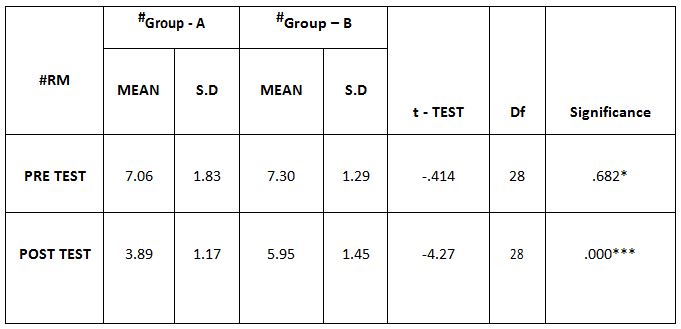
Table-1 Comparison Of Ruler Measurement Score Between Group – A And Group – B In Pre And Post Test

Group – B In Pre And Post  Test

Table –2 Comparison Of  Cranio-vertebral Angle Between Group – A And Group – B In Pre And Post Test

Comparison of  Cranio-vertebral Angle Between Group – A And Group – B In Pre And Post Test
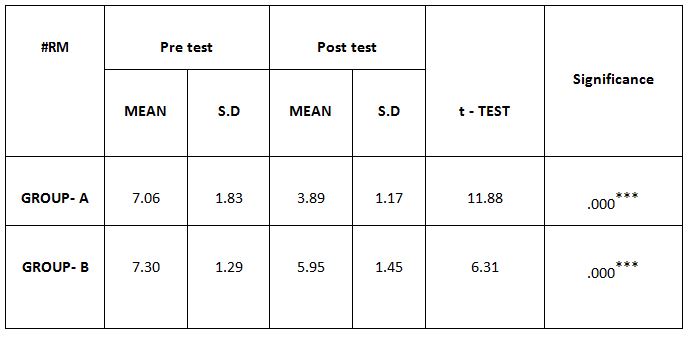
Table–3 Comparison of Ruler Measurement Score Within Group A & Group B Between Pre & Post Test Value

Comparison Of Ruler Measurement Score Within Group – A & Group – B Between Pre & Post Test Value
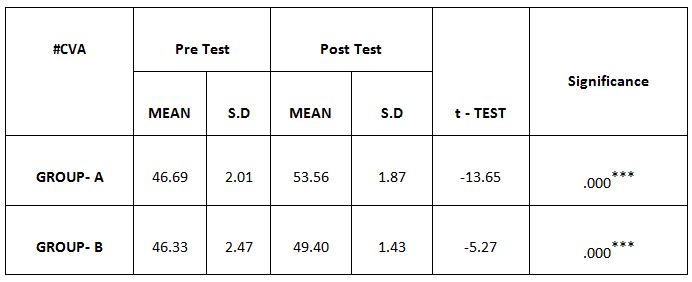
Table – 4 Comparison of Cranio-vertebral Angle Within Group – A & Group– B Between Pre & Post Test Values

RESULT

On comparing the pre and post test values within the experimental group, Group A & Group B on Ruler Measurement & Cranio-vertebral Angle shows highly significant difference in Mean values where p value is  P ≤ 0.001.Group A – Conventional Exerciseshows statistically significant improvement then Group B – Fencing Exercise.

DISCUSSION

In this world, almost everywhere including schools, colleges, offices and even in homes computers and Smartphone’s are commonly used today. Forward head posture is the misalignment of head on trunk, leads to increased lordotic curve of the cervical spine and accompanied by increased kyphosis of thoracic spine. Forward head posture leads to body mechanical deformation anterior to centerline of gravity, this reduces muscle strength of neck stabilization muscles, reduces

the activity of the stabilizer muscles of the scapulae and changes body mechanics of the scapulae. A sample of 30 subjects were selected and assessed then recorded the values. After, giving treatment the values are analyzed for significant differences. Cranio-vertebral angle is a good indicator for measuring forward head posture. The cranio-vertebral angle was measured using, ”On Protractor App” which is available on goggle play store 13,14.                          

A study on validity and reliability of “ON PROTRACTOR” smartphone application for measurement of cranio-vertebral and cranio-horizontal angle. In this study, the mean cranio-vertebral angle in non forward head posture is 50 degrees. The result of the study showed a effectiveness between conventional exercise and fencing exercise. This study proved that there was an increased effect in conventional exercise than fencing exercise after correction forward head posture 15.

The conventional exercise treatment showed improved ability in holding an upright posture of cervical spine and retraining these muscles was shown to reduce the neck symptoms and improved ability in maintaining an upright posture of cervical spine. The result showed that forward head posture significantly, reduced in the treatment groups after 4 weeks exercises, this improvement was also maintained after 1 month follow-up. Moreover, when compared with group A and group B, the forward head posture was reduced in group A (conventional exercise), which is effective 16.

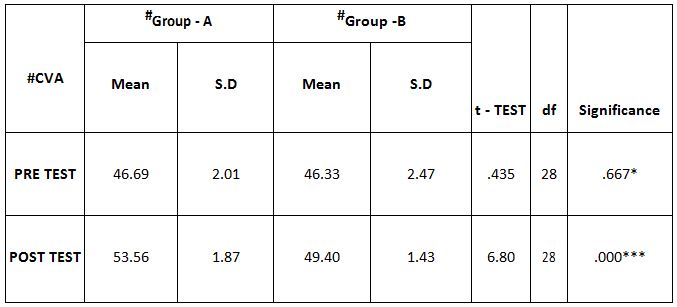
In this study 15 subjects were included for conventional exercise (Group-A). It supported on effect in forward head posture which reveals significant difference in mean values. In pre-test 7.09 in ruler measurement and 46.69 in cranio-vertebral angle. In post-test 3.89 in ruler measurement and 53.56 in cranio-vertebral angle.  Another 15 subjects included in fencing exercise (Group-B) .The fencing exercise also showed effect in forward head posture correction. The study reported significant differences in mean values. In pretest 7.30 in ruler measurement and 46.33 in cranio-vertebral angle. In post-test 5.95 in ruler measurement and 49.40 in cranio-vertebral angle.

Fencing is a great cardiovascular exercise, using several sets of muscles at a demanding intensity level over an extended period of time. The physical benefits of fencing include increased agility, balance, flexibility, Strength and cardiovascular endurance. While fencing is a whole exercise, it exercises the arms, thighs, buttocks hardest of all .You also benefit from fencing by gaining greater mental agility. Key muscles used for fencing exercise are, Upper body-Back muscles and Trapezius, Lower body-quadriceps, hip flexors, Gluteus, Hamstrings, Calves and core 17.

The purpose of this present study is to focus the effects of conventional exercise and fencing exercise in correction of forward head posture in younger adults. The conventional exercise is very effective because it demands deep muscles to work and strengthen muscles. Conventional exercise are very easy to learn and 15 subjects were practiced at home without the supervision of physiotherapist.These,15 subjects set remainder in their mobile phones to correct their posture and to do exercise regularly. They, also see mirror to correct their head posture which act as visual feedback. Because, of active participation of subjects in group A showed good and effective results.

In fencing exercise, especially in upper body few sets of muscles are used like trapezius, back muscles, biceps, triceps which is used for holding a wand and to keep shoulders in retracted position. The 15 subjects in group also actively participated for fencing exercise. To prevent unwanted consequences fencing exercise was done under the supervision of physiotherapist. Fencing exercise also showed values nearing to conventional exercise in 4 weeks duration. The pre-test and post-test of ruler measurement and cranio-vertebral angle in experimental groups is statistically significant at p<0.01 i.e. there is improvement in correction of forward head posture after treatment.

Ethical Clearance: Ethical clearance has obtained from Faculty of Physiotherapy, DR.MGR. Educational and Research Institute, Chennai to conduct this study with reference number: A-12/ PHSIO/IRB/2018-19dated 08/01/2019.

Conflict of interest:  The author reported no conflict of interest to do this study

Funding: The researchers had self financial support to conduct this research.

CONCLUSION

By the obtained result from this experimental study , it is concluded that there was improvement in forward head posture in both groups. However, conventional exercise(Group-A) showed more significant improvement than fencing exercise (Group-B) and corrects forward head posture and brings them back to normal posture.

REFERENCES

  1. Levangie P,Norkin C. (2012). Joint structure and function, 5th edition. New Delhi:Jaypee Brothers Medical publishers (P) Ltd; .P 502.
  2. Jung Won Kwon, Phd, PT, et ai. (2015). Changes in upper-extremity muscle activities due to head position in subjects with a forward head posture and rounded shoulders. J Phys Ther Sci; 27(6): 1739-1742.
  3. Gupta BD,Aggarwal S, Gupta B, Gupta M, Gupta N. (2013). Effect of Deep Cervical Flexor Training vs. Conventional Isometric Training on Forward Head Posture, Pain, Neck Disability Index In Dentists Suffering from Chronic Neck Pain. J Clin Diagn Res. 7(10):2261-4.
  4. Deborah Falla, Gwendolen Jull, et al.(2007). Effect of neck exercise on sitting posture in patients with chronic neck pain.Physical therapy 87 (4), 408-417.
  5. John S.Y. Chanaalan C.N. et al. (2011). Fencing expertise and physical fitness enhance action inhibition. Psychology of Sport and Exercise Volume 12, Issue 5, September Pages 509-514.
  6. Johnson, Gillian M., Dip Phty, Msc Spine. (1998). The Correlation between Surface Measurement of Head and Neck Posture and the Anatomic Position of the Upper Cervical Vertebrae. April 15, – Volume 23 – Issue 8 – p 921-927.
  7. Bhuvan Deep Gupta, Shagun Aggarwal, and Neha Gupta. (2013). Effect of Deep Cervical Flexor Training vs. Conventional Isometric Training on Forward Head Posture, Pain, Neck Disability Index In Dentists Suffering from Chronic Neck Pain. J Clin Diagn Res.; 7(10): 2261-2264.
  8. Alireza Rabieezadeh, et al. (2016). The relationship of height, weight and body mass index with curvature of spine kyphosis and lordosis in 12-15 year old male adolescents of Tehran. Turkish Journal of Sport and Exercise.6Year: -Volume: 18 – Issue: 3 – Pages: 42-46 .
  9. Kyeong-Jin Lee, et al.(2015).The effect of forward head posture on muscle activity during neck protraction and retraction. J. Phys. Ther. Sci. 27: 977-979.
  10. Jae Woong Han (2016). Biomechanical Analysis of Chin Tuck Exercise with a Subject-Specific Neck Model for the Forward Headed International Journal Of Precision Engineering And Manufacturing Vol. 19, No. 4, pp. 587-592.
  11. Jeong-Gon Na, et al. (2018). Effects of Exercise Type on Neck Disability, Pain, and Postural Changes in Subjects with Forward Head Posture: Systematic Review and Meta-Analysis. J Korean Soc Phys Med;13(3): 121-132.
  12. Lindsay M. Bottoms, et al (2011). Physiological responses and energy expenditure to stimulated epee fencing in elite female fencers. Serbian Journal of Sports Sciences, 5(1): 17-20.
  13. Jonathan D. Wiles, et al. (2018)  The safety of isometric exercise Rethinking the exercise prescription paradigm for those with Stage 1 hypertension. Wiles et al. Medicine 97:10.
  14. Minou Khakhali-Zavieh, et al. (2003) .The validity and reliability of measurement of thoracic kyphosis using flexible ruler in postural hyper kyphotic patients. Archives of Rehabilitation 4 (3), 18-23.
  15. Jay Smith, Brian R Kotajarvi, Denny J Padgett, Joe J Eischen. (2002). Effect of scapular protraction and retraction on isometric shoulder elevation strength. Archives of physical medicine and rehabilitation 83 (3), 367-370.
  16. Jerrold S Petrofsky, Richard L Burse, AR Lind. (1975). Comparison of physiological responses of women and men to isometric exercise. Journal of Applied Physiology 38 (5), 863-868.
  17. Karthikeyan selvaganapathy, Roshini Rajappan, Thom hung dee. (2017). The effect of smartphone addiction on craniovertebral angle and depression status amount university students. International journal of integrative medical sciences, vol4(5): 537-42.
Citation: S. M. Divya Mary, S. Bhargavy(2021). Effect of movement therapy in individuals with abnormal head posture , ijmaes; 7 (1); 960-968.

Effectiveness of progressive resisted exercises among women on bone mineral density

Vijayalakshmi B1, Padmanabhan K2

Corresponding Author:

1MPT Student, Faculty of physiotherapy, Dr. MGR. Educational and research institute University, Velappanchavadi, Chennai, Tamilnadu, India, Email id: vijayalakshmi260497@gmail.com

Author:

2Associate professor, Faculty of physiotherapy, Dr.MGR Educational and research institute University, Velappanchavadi, Chennai, Tamilnadu, India

ABSTRACT

Background of the study: Osteoporosis is reduced density of bone due to vitamin D deficiency, which can be prone for bone fracture. Bone mineral density (BMD) has to be checked routinely to screen out its deficiency. Osteoporotic fractures in India occur commonly in both sexes, and many occur at a younger age. Objectives of the study are to find the status of BMD among women using calcaneal ultrasound bone densitometer (QUS) and the effect of progressive resisted exercises (PRE) on BMD.
Methodology: It is an Experimental study, the study was conducted among women, of ‘’Bone Mineral Density Free Camp’’ organized at the ACS Medical College and hospital, Chennai. A total of 270 subjects (women) were screened by using Calcaneal Ultrasound Heel bone densitometer (QUS), out of which 66 subjects were detected with Osteoporosis. They were randomly assigned into Group A (Calcium supplements +Progressive Resistance Exercises) and Group B (Calcium supplements) by Randomized Control Trial (RCT) method. The duration of this study was three months.
Results: The study has reported there is a significant difference after post test t-score measurements between group A and group B. The mean of Group A was higher than that of Group B.
Conclusion: This study has recommended doing resistance exercises to prevent growing Osteoporosis among women. Calcaneal Ultrasound measurement could be a useful tool to asses BMD.  

Keywords: Osteoporosis, Bone mineral density, Progressive resisted exercises, Calcaneal Quantitative Ultrasound Densitometer.
Received on 22nd January 2021, Revised on 7th February 2021, Accepted on 26th February 2021; DOI:10.36678/IJMAES.2021.V07I01.005

INTRODUCTION 

Osteoporosis is a foremost cause of bone related health issues, which can lead to skeletal abnormalities including morbidity and socio economic troubles1. By 5th decades of life it is reported as most women are affected with osteoporosis. Early detection and treatment with adequate supplement is important to avoid complication of low bone mineral density 2, 3.

Currently the most widely used tool is Dual energy X-ray absorptiometry, which can measure density of skeleton both appendicular and axial, but portable ultrasound is most cost effective. It can measure the bone density more accurately with more cost effective and radiation free screening test 4, 5.

Quantitative Ultrasound (QUS) is the commonest device used to measure bone density. Bone density measurement sites include vertebra, hip, forearm and calcanium. QUS can rule out osteopenia of bone at any age of population6, 7.

Lack of exercises has been found to significantly associate with lower BMD in Indian women. Hormonal therapy is assumed to be helpful to prevent loss of bone density, which can leads to osteoporosis. Different exercise program has proved effect on bone absorption and prevent osteopenia. Best exercise program to prevent osteoporosis need to be developed. Adequate levels of estrogen, calcium intake, and vitamin D are essential along with exercise program to get best effect on prevention of osteoporosis8, 9, 10.

Objectives of the study were to find out the status of BMD among women using calcaneal ultrasound bone densitometer (QUS) and to find the effect of progressive resisted exercises (PRE) on the level of BMD.

METHODOLOGY

This is a comparative experimental study conducted by a camp based approach to screen out bone mineral deficiency. Free health check-up camps were organized in ACS Medical College and hospital, Velappanchavadi, Chennai. Total 66 patients were participated in this study.  The study was conducted for 3 months. Each week consist of 2 sessions per week.

Inclusion Criteria of the study were female subjects with age of above 35 years, subjects with osteoporosis.Exclusion Criteria were Systemic disease like renal disease and hepatic disorders, Rheumatoid arthritis, Endocrine disorders, Chronic medications of steroid and hormonal drugs, Impaired skin sensation, Any malignancy / infections, Metal implants, Poor hysterectomy and Known osteoporosis under treatment.

Materials used were treatment couch, towel, Chair, Stop watch, Sand bags and Assessment sheet. Outcome measured was bone mineral density by Quantitative Calcaneal Ultrasound (QUS) Bone densitometer.

Method: Based on the selection criteria 66 patients were randomly selected. Group A(n=33) Progressive Resisted Exercises for 30-45mins per session of twice per week for 3 months and Calcium Citrate supplements twice a day (800mg). Group B (n=33) Calcium Citrate supplements twice a day alone (800 mg).

Procedure: The subjects were selected based on inclusion and exclusion criteria. All the patients underwent pre-test assessment for Calcaneal Ultrasound on BMD. They were randomly assigned into two groups (Group A Progressive resisted exercises and calcium supplements) & (Group B calcium supplements only ). Written informed consent was taken.

Menstrual history, systemic illness, height and weight were checked before measure the bone mineral density. BMD was measured in Calcaneus (heel bone) ultrasound bone densitometer. QUS device used to measure BMD values in term of specific T-score criteria.  T-score of −1.0 or higher considered as normal and Osteopenia is defined when the score is between 1.0 and 2.5, Osteoporosis is defined as 2.5 or more.

Group-A

Exercises interventions: Progressive resisted exercises and calcium supplements: Exercise protocol (Lora M, Giangregorio et al): Week-1 (elimination of gravity), Hip Extension 3X8 at 10 %  , Knee Extension 3×8 at 10 %, Back Extension  3×8 at 10%, 1RM, Abdominal Flexion 3×8 at 10%, all exercise at 1RM, for week- 2 to 6 weeks 2 sets of 8-10 Repetitions At 1RM (against gravity).

Sit to stand or Squat, Wall Squat Combine with Lateral Pull, Squats to touch chairs- arms folded, Squat without touching chair, Standing Hip, extension and abduction 10 repetitions, progress to abduction. Perform these exercises and add resistance progress by sand bag.  Lunge 1 walking lunge; alternating legs, week-8 to 12 weeks (resistance against gravity), and the progression will be 15 repetitions at 60 to 80 % of 1RM.

Data analysis: The data were collected and analysed using both descriptive and inferential statistics .

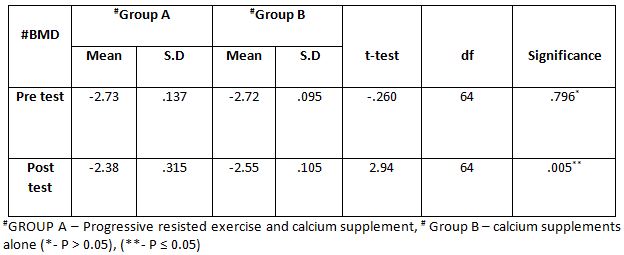
Table -1 Comparison of bone mass density (BMD) test between group -A and group -B in pre and post test

This table shows that there is no significant difference in pre-test values of the BMD between Group A & Group B and statistically significant difference in post-test values of the BMD  between  Group A & Group B

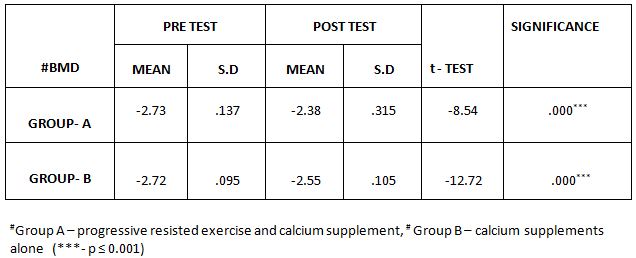
Table 2: Comparison of bone mass density (BMD) test values within Group-A & Group-B between pre & post test values

Based on the BMD values, it shows that there is a statistically significant difference between the pre- test and post -test values within Group-A and Group-B.

RESULTS

On comparing the mean values of Group A & Group B on Bone Mass Density (BMD) test values, it shows significant increase in the post test mean values but (Group A- Progressive  Resistance exercises and Calcium supplement) shows (-2.38) which has the higher mean value is effective than (Group B-Calcium Supplement alone) (-2.55) at P ≤ 0.05.Hence Null Hypothesis is rejected.

On comparing Pretest and Posttest within Group A & Group B on Bone Mass Density (BMD) Test Values shows significant difference in Mean values at P ≤ 0.001

DISCUSSION

This present study was based on camp conducted in ACS medical college and hospital, Chennai. The aim of the study was to evaluate

bone mineral density. The study reported the role of progressive resistance exercises in association with BMD. Women of 5th decade found more vulnerable for osteoporosis and bone fracture, so need to take more measures to prevent disability.

Osteoporotic changes are common among aged women than men. This has been reported as the mineral bone density is decrease with increase of age. Above 50 year are shown more prone for osteoporosis over 36.4% of women population. Fewer symptoms in early stage make the people to be less aware about low bone mineral density. Later stage with bone fracture leads the patients to measure bone density, by the time they would have developed osteoporosis. As BMD screening is not done routinely turns up the patients with fractures 11, 12.

Boneosteoblastic activity suppresses in both elderly male and female, it is common in women with aging.  Estrogen withdrawal in aged people suppresses osteoblastic activity and enhances osteoclastic activity.  Low BMD increases with age in both the sexes, so prevention of deficiency in BMD is essential to avoid complications. Timely intervention with proper nutrition and exercise can improve bone density and can prevent the progression of the condition 13, 14, 15.

In addition Progressive resistance exercises are found to be more effective in recent researches. Hence, for the women to be normal, she must be enrolled in effective exercises, adequate calcium intake along with their routine physical activities, despite the availability of gym with efficient friendly atmosphere for women is rarely found in India. To overcome these difficulties and to enroll women in exercise session and to educate them, home based Progressive resistance exercise protocols are intervened 16, 17,  18.

Ethical Clearance: Ethical clearance has obtained from Faculty of Physiotherapy, DR.MGR. Educational and Research Institute, Chennai to conduct this study with reference number: IV B051/ PHSIO/IRB/2017-18dated 08/01/2018.

Conflict of interest:  The author reported no conflict of interest to conduct and publish this article.

Funding:The researchers had self financial support to conduct this research.

CONCLUSION

The present study demonstrates that there is positive significant relation between Bone Mineral Density and Progressive Resistance Exercises among women. Hence, Progressive Resistance Exercises is an important determinate factor of Bone Mineral Density among women. Thus, more sensitive methods are recommended at this stage for formulating policy regarding preventive interventions. Through this study, we concluded that risk of Osteoporosis among women should be targeted for Resistance exercises to prevent growing increase of the condition and its complications.

REFERENCES

  1. Aggarwal N, etal. (2011). Prevalence and related risk factors of osteoporosis in peri and postmenopausal Indian women. J Midlife Health 2: 81-5.
  2. Syed Z, Khan A. (2002). Bone densitometry: Application and limitation. J obstet Gynaecol Can 24:476-84
  3. Cumming SR, et al. (1995). Risk factors for hip fracture in white women. Study of Osteoporotic Fractures Research Group. N Engl J Med.; 332(12):767-73.
  4. Sharma S, Tandon VR, Mahajan A, Kour A, Kumar D. (2006). Preliminary screening of osteoporosis and osteopenia in urban women from Jammu using calcaneal QUS. Indian J Med Sci; 60:183-9.
  5. Shatrugna V, Kulkarni B, Kumar PA, Rani KU, Balakrishna N. (2005). Bone status of Indian women from a lowincome group and its relationship to the nutritional status. Osteoporos Int.; 16(12):1827-35.
  6. Kataria SK, Pareek P, Dadhich A, Kataria KR, Bhati M. (2012). The effect of body mass index on bone mineral density in pre and postmenopausal women of western Rajasthan population. Int J Biol Med Res. 3(3):1899-1901.
  7. Anburanjan M, Kumar D A,  Sapthagirivasan V. (2011). Evaluation of osteoporosis in Indian women and men usingp DXA. Academia.ed. International conference on bioscience, biochemistry & bioinformatics (ICBBB- 2011), ISBN: 978-1-4244-9388-3 pp 470-474,.
  8. Shukla J, Sarkar PD, Bafna A, Shukla N. (2013). A retrospective study to investigate association among age, BMI and BMD in postmenopausal women. IOSR-Journal of pharmacy and biological sciences, 6(2):93-6.
  9. Widmaier EP, Raff H, Strang KT. (2011). Vander’s human physiology the mechanisms of body function. 12th edn. New York: McGraw-Hill; p. 345-48.
  10. Navarro MC, Sosa M, et al. (2009). Poverty is a risk factor for osteoporotic fractures. Osteoporos Int. Mar; 20(3): 393-8.
  11. Paul TV, Thomas N, et al. (2008). Prevalence of osteoporosis in ambulatory postmenopausal women from semi-urban region in south India: relationship to calcium nutrition and vitamin D status. Endocr Pract., 14(6):665-71.
  12. Baheirai A, Pocock NA, et al. (2005). Bone mineral density, body mass index and cigarette smoking among Iranian women: implications for prevention. BMC Musculoskelet Disord. 6:34.
  13. Salamat MR, Salamat AH, Abedi I, Janghorbani M. (2013). Relationship between weight, body mass index and bone mineral density in men referred for dual-energy X-ray absorptiometry scan in Isfahan, Iran. J Osteoporosis 2013:205963.
Citation: Vijayalakshmi B, Padmanabhan K(2021). Effectiveness of progressive resisted exercises among women on bone mineral density , ijmaes; 7 (1); 954-959.

Effect of inspiratory muscle training in patients with chronic obstructive pulmonary disease on dysponea and exercise tolerance

Syeda Khanam. P1, Manjunatha. H2, Thummala S. Pavani3

Corresponding Author:

1Professor, East College of Physiotherapy, Bidrahalli, Bangalore, Karnataka, India

Co Authors:

2Principal, East College of Physiotherapy, Bidrahalli, Bangalore, Karnataka, India3Assistant Professor, East College of Physiotherapy, Bidrahalli, Bangalore, Karnataka, India     

 ABSTRACT   

Background and purpose: This study was to find the effect of inspiratory muscle training on dyspnoea and exercise tolerance among chronic obstructive pulmonary disease patients.

Methods: It is a randomized control study of 30 COPD participants with 15 in each control and experimental group. Experimental group underwent inspiratory muscle training with threshold IMT device in the physiotherapy department, where subjects have to breathe against various threshold levels, 30sets/sessions where as control group underwent only breathing and general mobility exercises at home. The training lasted for 20-30 minutes, twice daily 6days per week, and was continued over the course of 4 weeks duration. Parameters included were 6minutes walk test, MRC dyspnoea grade, PEFR values. The data collected data of control and experimental group was compared to find the outcome.

Results: Before interventions, all patients showed increased dyspnoea levels and reduced exercise tolerance. After interventions they all exhibited reduced dyspnea and increased exercise tolerance based on 6min walk test, MRC dyspnoea grade, PERF Parameters. Control group patients didn’t exhibit any improvement in any of the parameters.

Conclusion: The results support that inspiratory muscle training is more effective on reducing dyspnoea and increasing exercise tolerance among COPD patients.
 
Keywords: Chronic Obstructive Pulmonary; Dyspnoea; Exercise tolerance; Inspiratory muscle training
Received on 20th January 2021, Revised on 4th February 2021, Accepted on 24th February 2021; DOI:10.36678/IJMAES.2021.V07I01.003

INTRODUCTION 

Chronic obstructive pulmonary disease is a condition characterized by narrowing of airway tract with symptoms of chronic cough, expectoration, wheeze and exertion dyspnoea. COPD can develop and progress by 25% risk factors of smoking and to mortality by 15% with addiction of smoking 1-3.

Diaphragm is the main inspiratory muscle morphologically and functionally responds to the inspiratory muscle training. There are evidence documented in possibility of resultant accumulation of co2 takes place even after resolution of acute exacerbation of conditions and relative obstruction of airway 4, 5.

The IMT device can help to do inspiratory training exercise which can increase strength of inspiratory muscle; there by it can improve the threshold of inspiratory resistance. Overall health related quality of life (HRQL) can improve by repeated inspiratory muscle training. The exercise training decrease dyspnoea and work of breathing becomes easier in patients with COPD. Regular inspiratory training can facilitate to perform physical activities more easily 6-10.

Aims and objectives of the study was to find the effect of inspiratory muscle strength and endurance to increase exercise tolerance, decrease work of breathing, and to improve functional exercise capacity and also to increase overall health related quality of life.

METHODOLOGY

The study Design was Randomized control study. Data collected were from the patients recruited from pulmonology OPD and treated in the physiotherapy department, Nizam’s institute of medical sciences, punjagutta Hyderabad. Patients were assessed thoroughly and treated during the trails. Period of study intervention was 4 weeks and materials used were threshold inspiratory muscle trainer.

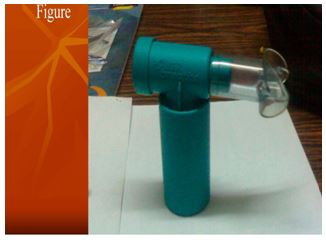
Figure 1: Peak Expiratory Flow Meter

Peak expiratory flow meter is used to record the peak expiratory air flow rate of a person. The forced expiratory volume of a person is measured using this device. The forced expiratory volume of a person is measured using this device. The forced expiratory volume is given in liters’/minute. In COPD patients the PEFR is altered due to biomechanics of chest.

GAIAMS*Power breathe provides a threshold resistance during inspiratory phase. It helps in increasing strength and endurance of respiratory muscles, reduce severity of dyspnoea and improves exercise capacity patients with COPD, asthma, cystic fibrosis, chronic  heart failure,chronic spinal injury, muscular dystrophy, before cardio thoracic surgery.Materials required for the study was Sphygmomanometer, Stop watch, and Measure tape 11-14.

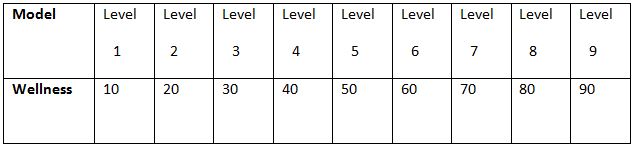
It has got 9 levels and load varies from level 1 to level 9, approximately as follows: Load (-cm H2O).

Table 1: 9 levels and load

Intensity: 10% to 52% of maximal inspiratory pressure (PI Max).most commonly used training device in these studies is threshold IMT. Frequency of the study duration was 7days/week and total duration of the study was 4 weeks, 20-30 min session, twice a day.

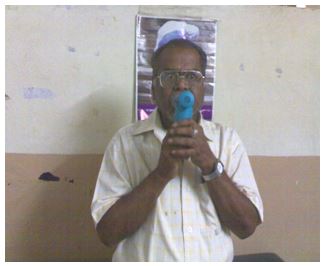
Procedure: Subject has to sit in a  high sitting position on a couch, hold the apparatus close to the mouth and take deep breathe against the resistance set with in the threshold IMT apparatus and blow air out relax. Patient has to repeat the same for 30 times. This procedure should be done twice a day, 30 minute every session. Patient is instructed properly and to discontinue usage if they have symptoms of breathlessness and cough.

Figure 2: Patient performing inspiratory muscle training

Inclusive criteria for this study was Mild and moderate exacerbation of COPD

Exclusive criteria for  this study was Severe exacerbation of COPD, Pulmonary tuberculosis, Restrictive lung disease, Severe asthma, neuro muscular disorders, musculo skeletal problems of spine, Heart failure/unstable angina and  Peripheral vascular diseases.

The data collected ranged from parameters: 6 min walk test, Peak expiratory flow rate, and MRC dyspnoea grading.

During study period 60 patients were examined who were all COPDS associated with other problems but only 30 met the inclusive criteria.15 patients were assigned for group A and remaining 15 for group B according to randomized control study. Their mean ages (group A 58.13; group B 52.06) were calculated.

Data analysis and results:  All data analysis was computed with statistics, paired T-test .within groups, student T-test between groups and mean values were used for both groups to determine the difference between outcome measures of 6 min walk test, MRC dyspnoea and PEFR. Level of significance was fixed as 5 % for the present study.

Out of large proportion COPD with mild and moderate exacerbation the sample taken for the study is 30,based on convenience sampling method after thorough examination based on inclusive criteria from the department of physiotherapy.30 participants were present for the whole duration of the study 4 (week).

During 4 week of study course the parameters studied were 6 min walk test, MRC dyspnoea scale, Peak expiratory flow rate.

The data was collected on subject on 1st week and 4th week, and raw data was arranged in order to maintain the master chart, which was subjected to further statistical analysis.

To find out of the average line score in above mentioned parameters in each subject the means were calculated at 1st week and these values were considered as base line values for the study simultaneously the same parameters are studied at 4th week and average variations were recorded in terms of means of each parameters and the variations from the mean were also calculated.

The difference in each parameter from 1-4 weeks was tested with paired T-test, within group and student T-test between groups, finally the observed variations in each parameter was represented in graphical format for easy understanding.

RESULTS

From 1st week to 4th week all the parameters collected from the data are arranged in master chart for further statistical analysis .The difference in each parameter from 1st week(initial )to the end of 4th week(final),of the subject is shown in the following tables.

6 Min Walk Test:  The performance of 6min walk test was conducted for both the groups (Experimental and control group) that to in particular time schedule (1st week to 4th week). 1st week taken as base period which is compared with other time factors, combination allay. Different variables were studied between: 1st week-4th week. For with group paired T-test was performed and among two different groups student T-test was used; same tests are used for other parameters MRC dyspnea, PEFR too.

Within Control Group: Among all the variables within the control group, paired T-test calculated value for 1st -4th week is 1.00000 and the table value is 2.145 at 5%level of significance with 14 degrees of freedom.

Table 2: 6min walk test within control Group
Table 3: 6min walk test within Experimental Group

Within Experimental Group:  Among all the variables within the experimental group, paired T –test calculated value for 1st week -4thweeks is 14.58441 and the table value is 2.145 at 5% level of significance improvement in 6minute walk in experimental group to control

Table 4: 6min walk test between control and Experimental Group

Between Control Group and Experimental Group: Between control and experimental group student T-test was performed. Among all the variables the student T- test calculated values for 1st and 4th week (2.24).

The tabulated value at 5% level of significance with 28 degree of freedom is 2.049 showing the significant difference.

Table 5: MRC Grading of Dyspnea within Control Group

MRC Grading of Dyspnea within Control Group: Among all the variables with in control group, paired T-test calculated value for 1st week-4th week is less than 1.000 and the Table value is 2.145 at 5%level of significance with 14 degrees of freedom.

Table 6: MRC Grading of Dyspnea within experimental Group

MRC Grading of Dyspnea within Experimental Group: Among all the variables within the experimental group, paired T –test calculated value for 1st week -4th weeks is 5.69 and the

table value is 2.15 at 5% level of significance improvement in dyspnoea levels in experimental group to control

Table 7: MRC Grading of Dyspnea between Control Group and experimental Group

MRC Grading of Dyspnea between Control Group and Experimental Group: Between control and experimental group student T-test was performed. Among all the variables the

student T- test calculated values between1st and 4th week (6.25).The tabulated value at 5% level of significance with 28 degree of freedom is 2.05 showing the significant difference.

Table 8: Peak expiratory flow rate within control Group

Peak expiratory flow rate within Control Group:Among all the variables within the control group, paired T-test calculated value for

1st -4th week is 1.46759 and the table value is 2.145 at 5%level of significance with 14 degrees of freedom.

Table 9: Peak expiratory flow rate within Experimental Group

Peak expiratory flow rate within Experimental Group: Among all the variables within the experimental group, paired T –test calculated value for 1st week -4th weeks is 9.57556 and the

table value is 2.145 at 5% level of significance  with 14 degrees of freedom showing  significant improvement in PEFR values  in experimental group compared  to control

Table 10: Peak expiratory flow rate between control and Experimental Group

Between Control Group and Experimental Group: Between control and experimental group student T-test was performed. Among all the variables the student T- test calculated values for 1st and 4th week (4.09).The tabulated value at 5% level of significance with 28 degree of freedom is 2.05 showing the significant difference.

DISCUSSION

COPD is progressive and irreversible disorder of airway. Therefore even after resolution of acute exacerbation of condition there may be relative obstruction of airway. So complete expiration is not possible after resultant accumulation of Co2. Therefore, these patients frequently report dyspnoea related to activities of daily living, such patients are considered as stable COPD patients. The symptom induced inactivity leading to deconditioning and muscle weakness & thus resulting into crucial impact of functional and health status15-17.

The present study has done on patients with mild and moderate COPD for 4 weeks showed significant effects of IMT on dyspnoea &exercise tolerance.  Many studies have reported the effect of inspiratory muscle training on dyspnoea and exercise tolerance among COPD Patients. Parameters included in this study are 6 minute walk distance test, PEFR, and MRC grading of dyspnoea.

In experimental group in present study the mean improvement in 6 minute walk distance at the end of 4 weeks of training is 109.4 m, T cal values 14.584, T tab value 2.145, showing significant improvement. In control group the mean difference in 6 min walk is 3.2 m at the end of 4th week T cal values 1.000, T tab value 2.145, showing no significant improvement. The limiting factors for reduced exercise tolerance in patients with COPD are dyspnoea. The increase in 6 min walk distance could be because of reduction in dyspnoea, increased exercise tolerance.

PEFR mean difference within the experimental group is78.66 T cal values at the end of 4th week is 9.576 and the, T tab value 2.145, showing significant improvement compared to control group where the mean difference is 1.33, T cal values 1.468, T tab value 2.145. MRC grading of dyspnoea within experimental group at end of 4th week the mean difference is 1.33, T cal values 5.69, T tab value 2.15, showing significant changes in dyspnoea levels in experimental group compared to control where there is no significant changes in mean values, at the end of 4th week T cal values is less than 1.000, and T tab value is 2.145.

A study on specific inspiratory and specific expiratory muscle training has proved both are effective on improving respiratory function, specifically it could reduce dyspnoea and improve exercise performance. There was no difference in effect on the outcomes when the patient performed combined specific inspiratory and expiratory muscle training exercise program among COPD Patients 18-20.

The effect of specific expiratory muscle training for one year among COPD patients have shown, it improves in respiratory muscle strength and health related quality of life.  The study has also reported maximal inspiratory pressure and improves 6 minute walk distance and a decrease in the mean Borg score during breathing against resistance scores. Some studies have reported inspiratory muscle training has improved functional exercise capacity and strength of respiratory muscles 21, 22.

Present study even showed significant improvement in dyspnoea, exercise tolerance in COPD who underwent IMT for 4 weeks. Most commonly used training device in these studies is threshold IMT where intensity varied from 10% to 52% (high) of maximal inspiratory pressure (PI max) 20-30 min session, twice a day.

The reduction in dyspnoea due to IMT could be due to increased inspiratory muscle strength as determined 20% Larson et al. study (1999), 34% Lisboa et al(1997), 25%weiner et al (2000),50%, Sachez Riera et al (2016).

Inspiratory muscle training for five weeks has proved effect on external intercostals muscles with strong evidence of biopsy report on increase in size of type 2muscle fibers among COPD patients.

A study among COPD patients in Spain, they have analyzed health related quality of life (HRQL) using Questionnaire after inspiratory muscle training and found effect on outcomes of sustained maximal inspiratory pressures, shuttle walk test, in experimental group.

Comparatively the present study even showed significant changes and improvement in dyspnoea and exercise tolerance on mild and moderate COPD patients where the duration of the study was for 4 weeks and the outcome measures used were 6 min walk test, MRC dyspnoea grade and PEFR values. Experimental group showed significant improvement in all these outcome measures than the control group.

In a study conducted at south Korea, the effects of inspiratory muscle training has reported the changes in outcome measures of FEV1, level of dyspnoea based on Borgs score, and 6 min walk distance, they were analyzed in experimental group and showed decreased perception of dyspnoea and improved exercise capacity among moderate to severe obstructive components in the presentation of COPD.

Comparatively in the present study subjects were only mild, moderate COPD patients where control group did not participate in IMT for 4 weeks but practiced general mobility exercises and breathing exercises where as experimental group who underwent inspiratory muscle training showed significant improvement in dyspnoea and exercise tolerance.

The meta-analysis has reported the effect of inspiratory muscle training on inspiratory muscle strength and endurance, improved functional exercise capacity and decreased dyspnoea in patients with COPD. The documented effects of inspiratory muscle training were examined in a meta-analysis. The study is also recommended inspiratory muscle training is a very essential addition to pulmonary rehabilitation programs.

In the present study done on patients with mild and moderate COPD for 4 weeks the experimental group showed significant effects of IMT on dyspnoea &exercise tolerance than control group who underwent only breathing and general mobility exercises.

The studies conducted were performed on a limited number of subjects. Further study is required on a large group to quantitatively analyze the results of IMT on large scale.

Ethical Clearance: Ethical clearance has obtained from Faculty of Physiotherapy, Nizam’s Institute of Medical Sciences, Punjagutta, Hyderabad on 02/05/2008 to conduct this study.

Conflict of interest: There was no conflict of interest to conduct this study.

Fund for the study: It was aself financed study.

CONCLUSION

The study has concluded from the study that inspiratory muscle training can reduce dyspnoea and improved exercise tolerance in COPD patients with mild and moderate exacerbation. The study has also supported the exercise program can improve overall health related quality of life (HRQL) among COPD patients.

Limitations: Limitations of the study were small sample size, short time training period, IMT apparatus is not accessible and it is cost effective for the patients and study was limited to a specific group of mild and moderate COPD.

Future Direction: The present study can be extended for long term rehabilitation. Future study can imply IMT on severe exacerbation of COPD/chronic asthma, cystic fibrosis, pre op lung conditions such as lobectomy, pneumonectomy. Pre and post training PI Max value of IMT can be taken to further strengthen the study, and also can imply expiratory muscle training.

REFERENCES

  1. Nice, L (2000). Mechanism and measures of exercise intolerance in chronic obstructive lung disease.Clin Chest Med 21, 693-704.
  2. Van’tHul, HA, Gosselink, R, Kwakkel, G (2003). Constant-load cycle endurance performance; Test-Retest reliability and validity in patients with COPD. J Cardio-pulmo rehabil. 143-150.
  3. Polkey, MI, Moxham, J, (2004). Improvement in volitional tests of muscle function alone may not be adequate evidence that inspiratory muscle training is effective Eur Respir. J, 23, 5-6.
  4. Holm, P, Sattler, A, Fregosi, RF (2004). Endurance training of respiratory muscle improves cycling performance in fit young cyclists.BMC Physio., 4: 9.
  5. Weiner, P, Magadle,R, Beckerman, M, et al (2003). Specific expiratory muscle training in COPD. Chest 124, 468-473.
  6. Weiner, P, Magadle, R, Beckerman, M, et al (2003). Comparison of specific expiratory, inspiratory and combined muscle training program in COPD Chest 124, 1357-1367.
  7. Bourjeily, G, Rochester, C L, (2000). Exercise training in chronic obstructive pulmonary disease, Clinical chest med, 21,763-781.
  8. Caine MP and MC Connell AK (2000). Development and evaluation of a pressure threshold inspiratory muscle trainer for use in the context of sports performance. Sports Engin 3,149-159.
  9. Covey MK, Larson JL, Wirtz SE, Berry JK, Pogue NJ, Alex CG and Patel M., (2001). High intensity inspiratory muscle training in patients with chronic, obstructive pulmonary disease and severely reduced function. J. Cardiopul. Rehabil. 21; 231-240.
  10. Lotters, F, Kwarkkel, G, Gosselink, R. (2002). Effect on controlled inspiratory muscle training in patients with COPD.A Meta-analysis. European Respiratory Journal, 20,570-577.
  11. Oh, Eui-Geum. (2003).The Effect of home-Based pulmonary Rehabilitation in patients with chronic lung disease. International journal of nursing studies, 40, 873-880.
  12. Beckerman, Marinella, Magadle, R, (2005, November). The effect of one year of specific inspiratory muscle training in patients with COPD. Chest, 5, 3177-3183.
  13. Martin, Daniel, (2002). Use of inspiratory muscle strength training to facilitate ventilator weaning. Chest 122,192-196.
  14. Sanchez, RH, Monte mayor, RT, Ortega, RF, et al. (2001). Inspiratory muscle training in patients, with COPD; Effect on dyspnoea, exercise performance, and quality of life chest 120,748-756.
  15. De Jong W, Van Aalderen WM, Koeter GH, and van der schans CP.(2001). Inspiratory muscle training in patients with cystic fibrosis. Respir Med., 95: 31-36.
  16. Enright, S, Chatman, K, Lonescu, A.(2004). Inspiratory muscle training improves lung function and exercise capacity in adults with cystic fibrosis. Chest, 2, 405-412.
  17. Lisobia, C, Munoz, V, Beroza, T, Leiva, A, Cruz, E, (1994). Inspiratory muscle training in chronic airflow limitation: A compensation of two different training loads with a Threshold Device European Respiratory Journal, 7, 1266-1274.
Citation:   Syeda Khanam. P, Manjunatha. H, Thummala S. Pavani (2021). Effect of Inspiratory Muscle Training in Patients with Chronic Obstructive Pulmonary Disease on Dysponea and Exercise Tolerance, ijmaes; 7 (1); 933-942.

Overview of the health profile of the elderly referring to the risks of stroke in the sub-district of Cililitan, Jakarta, Indonesia

Rosintan Milana Napitupulu1, Novlinda Susy Anrianawaty Manurung2

Corresponding author:

1Physiotherapy Program, Faculty of Vocational Studies, Universitas Kristen Indonesia.

Mail id: rosintan.napitupulu@uki.ac.id

Co-Author:

2 Physiotherapy Program, Faculty of Vocational Studies, Universitas Kristen Indonesia

ABSTRACT

Introduction: The composition of the elderly population is increasing rapidly in both developed and developing countries, which is caused by a decrease in fertility (birth) and mortality (death) rates as well as an increase in life expectancy, which changes the structure of the population as a whole. Stroke can generally occur in all age groups, but three quarters of strokes occur in people who are already 65 years old or older (the elderly) and result in the onset of disability or invalidity. Stroke is one of non-communicable diseases, which is the leading cause of death worldwide.
Methodology: Data was taken from the integrated health service post (for the elderly) to obtain an overview of the risk of stroke in the elderly based on the available secondary health data of the elderly.
Results: Two hundred and sixty-eight (268) elderly people with the available health data can be described by the following criteria: 56% of the elderly have low risk, 32% of the elderly have moderate risk, and 12% of the elderly have high risk.
Conclusion: The elderly in the integrated health service post for the elderly have various risks of stroke from moderate to high.

Keywords: Risk of stroke; Physiotherapy; Health status; Elderly  
Received on 18th January 2021, Revised on 24th January 2021, Accepted on 20th February 2021; DOI:10.36678/IJMAES.2021.V07I01.002

INTRODUCTION 

Stroke is one of non-communicable diseases, which is the leading cause of death 1,2. Stroke is included in cerebrovascular disease, which is a brain function disorder associated with the disease of a blood vessel that supplies blood to the brain3. Stroke is also called a brain attack which always occurs suddenly with various symptoms. However, most of the symptoms that are often found are the condition of the body that is half paralyzed and/or accompanied by decreased consciousness4. Stroke can generally occur in all age groups, but three-quarters of strokes occur in people who are already 65 years old or older (the elderly) and result in the onset of disability or disorders 5.

 The large number of elderly people in Indonesia will have both positive and negative impacts. It has a positive impact if the elderly population is healthy, active, and productive. On the other hand, the large number of the elderly population becomes a burden if they have a problem of declining health which results in an increase in the cost of health services, a decrease in revenue/income, an increase in disability, the absence of social support, and an environment that is not friendly to the elderly population6.

Based on the magnitude of the problem that will arise due to stroke in the elderly, we consider it important to portray or describe the risk of stroke that exists in the elderly in sub-district of Cililitan, Jakarta, Indonesia as an area that is fostered by Universitas Kristen Indonesia. We processed the secondary data on the health of the elderly to describe the risks of stroke that exist in the elderly in this area. The research was conducted at the Integrated Health Service center for the elderly of Cililitan because it is one of the Integrated Health Service center that also fostered by the UniversitasKristen Indonesia, so further research is needed to increase the role of the university to the community in terms of health, disease prevention, and improvement of public health.

RESEARCH METHODOLOGY

The methodology of this research is a descriptive study by taking secondary data from the Integrated Health Service Centre for the elderly in Sub-District of Cililitan, Jakarta, Indonesia. The selection of this integrated health service post was based on its collaboration with the Universitas Kristen Indonesia, so that community service-based research could be carried out. The data taken was then processed using a cross sectional study method.

Secondary data was obtained from the report on the results of examining the general condition of the elderly made by health workers from the integrated health service post for the elderly with the examination period in March 2020. The data used is on routine health checks carried out by health care professionals at the integrated health service center for the elderly. The use of data in this study has received permission from the management of the integrated health service post by not displaying the identity of the elderly.

Data analysis: The data obtained is the health data of the elderly which includes: blood pressure, random blood sugar level, cholesterol, age, and sex. This secondary data was processed using Microsoft Excel software in order to obtain an overview of the risk of stroke in the integrated health service center for the elderly of Sub-District of Cililitan.

RESULTS and DISCUSSION

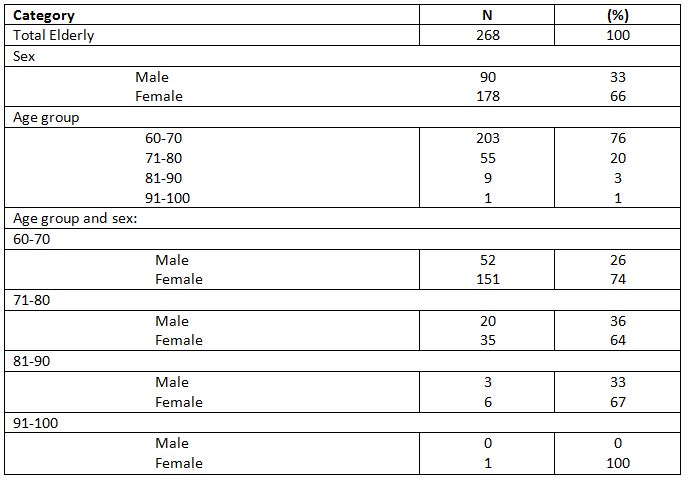
The following is the data obtained through the secondary data available in the integrated health service post for the elderly taken in March 2020. The data in Table 1 shows the profile of the elderly at the integrated health service center for the elderly.

Table 1. Profile of the Elderly

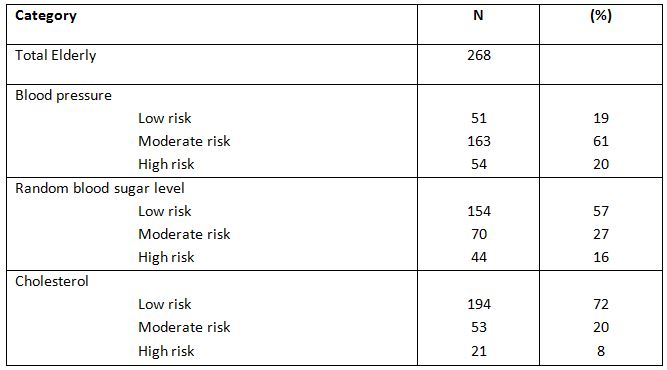
Thereafter, from the profile of the elderly, the researchers continued to process the health profile data of the elderly consisting of the conditions of blood pressure, blood sugar, and cholesterol.

Table 2. Health Profile of the Elderly

Based on the results of the profile data processing in the form of sex and age shown in Table 1 above, it is known that there are 268 elderly people consisting of 33% males (90 people) and 66% females (178 people), with 76% (203 people) in the age range of 60-70 years, 20% (55 people) in the age range of 71-80 years, 3% (9 people) in the age range of 81-90 years, and 1% (1 person) in the age range of 91-100 years. In this data, it is found that most of the elderly are female. In the study, stroke is more common in men aged 65-79 years although older women can also be at higher risk, namely those over 80 years 7,8.

Based on the health profile shown in Table 3, there are three important factors that constitute indicators in the assessment of potential risks of stroke, such as:blood pressure, blood sugar, and cholesterol. A study also explains that those three indicators can be initial risk assessment for stroke conditions 5.

In the data processing table of the recorded results of medical examination based on blood pressure, it is concluded that 19% (51 people) of the elderly havea low risk potential, 61% (163 people) have a moderate risk potential, and 20% (54 people) have a high risk potential of stroke. It is also supported by a study conducted by Seshadri et al., which actually states that high blood pressure would result in higher risk of stroke in the elderly below 80 years old9. It is also visible from the data that such condition can also affect more than 70 percent of the elderly in the integrated health service center. A study conducted by Rodgers et al. also states that hypertension in the elderly can also result in a higher risk for the occurrence of stroke in the elderly5. A study conducted by Arboix et al. also states that high blood pressure conditions play a major role in increasing the risk of ischemic stroke in the elderly who are older than 85 years or more10.

In the data processing table of the recorded results of medical examination based on random blood sugar level,it was found that 57% (154 people) of the elderly have a low risk potential, 27% (70 people) have a moderate risk potential, and 16% (44 people) have a high risk potential of stroke. In general, the blood sugar condition and other conditions such as food management are also influential to the risk level of strokein the elderly 11.

In the data processing table of the recorded results of medical examination based on cholesterol, it was found that 72% (194 people) of the elderly have a low risk potential, 20% (53 people) have a moderate risk potential, and 8% (21 people) have a high risk potential. It can be said that most of the elderly are still safe in terms of cholesterol contained in the blood as a stroke risk parameter. Nevertheless, high cholesterol levels in the blood can be one of the risks that result in stroke among the elderly4. A study conducted by Reddy et al. stated that, besides the risks of diabetes and hypertension, dyslipidemia, obesity, smoking, and drinking alcohol can also increase the risk of stroke in the elderly12.

In this study, there were still more elderly women who came regularly, so that the data presented has not covered all the elderly. The data displayed is also only the data taken in the month of March. The activities in the integrated health service post for the elderly need to be enhanced with simple exercises that can increase physical activity in the elderly to help improve general health 13.

Ethical Clearance: Ethical clearance has obtained from Universitas Kristen Indonesia, Jakarta, Indonesia to conduct this study with reference number: 309/UKI.F8.D/PPM dated 01/06/2020.

Conflicts of Interest: The author declares that there is no competing interest in publishing this article.

Fund for the study: This is self-funded study.

Recommendation: The participation of elderly men in the integrated health service post needs to be increased, so that the elderly men who are at risk can be recorded because, based on data, many men have the risk of stroke. Health examination in the integrated public health service center for the elderly needs to be conducted regularly which needs to be supplemented with exercises or gymnastics for the elderly to improve their health condition. Simple exercises to increase physical activities can improve the health condition of the elderly.

CONCLUSION

As a conclusion, the elderly in the integrated health service center have quite various stroke risk potentials from moderate to high. In such conditions, information about health condition needs to be disseminated about the basic risks that would result in stroke also with initial handling for the prevention of stroke.

REFERENCES

  1. Hu, G., Sarti, C., Jousilahti, P., Peltonen, M., Qiao, Q., Antikainen, R., &Tuomilehto, J. (2005). The impact of history of hypertension and type-2 diabetes at baseline on the incidence of stroke and stroke mortality. Stroke, 36(12),2538-2543.
  2. Feigin, V. L., Krishnamurthi, R. V., Parmar, P., Norrving, B., Mensah, G. A., Bennett, D. A., & Davis, S. (2015). Update on the global burden of ischemic and hemorrhagic stroke in 1990-2013: the GBD 2013 study. Neuroepidemiology, 45(3), 161-176.
  3. Dávalos, A. (2005). Thrombolysis in acute ischemic stroke: successes, failures, and new hopes. Cerebrovascular Diseases, 20 (Suppl. 2), 135-139.
  4. Chen, R. L., Balami, J. S., Esiri, M. M., Chen, L. K., & Buchan, A. M. (2010). Ischemic stroke in the elderly: an overview of evidence. Nature Reviews Neurology, 6(5), 256-265.
  5. Rodgers, H., Greenaway, J., Davies, T., Wood, R., Steen, N., & Thomson, R. (2004). Risk factors for first-ever stroke in older people in the north East of England: a population-based study. Stroke, 35(1),7-11.
  6. Parr, E., Ferdinand, P., &Roffe, C. (2017). Management of Acute Stroke in the Older Person. Geriatrics, 2(3),27.
  7. Appelros, P., Stegmayr, B., &Terént, A. (2009). Sex differences in stroke epidemiology: a systematic review.  Stroke, 40(4), 1082-1090.
  8. Arboix, A., Oliveres, M., García-Eroles, L., Maragall, C., Massons, J., & Targa, C. (2001). Acute cerebrovascular disease in women. European neurology, 45(4), 199-205.
  9. Seshadri, S., Wolf, P. A., Beiser, A., Vasan, R. S., Wilson, P. W., Kase, C. S., & D’Agostino, R. B. (2001). Elevated midlife blood pressure increases stroke risk in elderly persons: the Framingham Study. Archives of internal medicine, 161(19), 2343-2350.
Citation:  Rosintan Milana Napitupulu, Novlinda Susy Anrianawaty Manurung (2021). Overview of the health profile of the elderly referring to the risks of stroke in the Sub-district of Cililitan, Jakarta, Indonesia , ijmaes; 7 (1); 927-932.

A study to find the effectiveness of iontophoresis with open kinematic chain exercises in pes anserine bursitis in sports persons

Gummadi Ashish1

Coresponding Author:

1Senior Physical therapist, Department of Neurorehabilitation, Institute of Neurosciences, Kolkata, Mail id: ashishgummadi@gmail.com

Aim and background of the study: Pes Anserine Bursitis is an inflammatory condition of pes anserine bursa which affects medial and inferio- medial aspect of the knee with more painful and swelling around the knee joint. Aim of the study is to find the effectiveness of iontophoresis and open kinematic chain exercises on pain, and knee range of motion of sports person with pes anserine bursitis.
Methodology: 30 male and female subjects according to inclusion and exclusion criteria were randomly divided into two groups for the study where, Experimental Group was treated with Iontophoresis and open kinematic chain exercise. Control Group was treated with Ultrasound therapy.
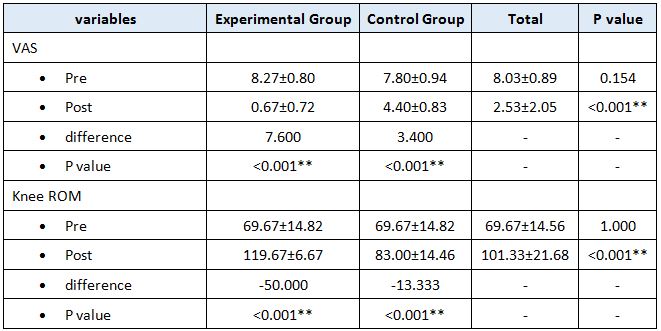
Result: The study reported  the Group  treated with Iontophoresis and open kinematic chain exercise got significant improvement in VAS and KROM score with p=0.001.
Conclusion: the study concluded that the experimental group which received iontophoresis along with open kinematic chain exercises demonstrated good effect in reducing pain and increasing Knee ROM.

Key Words: Iontophoresis, open kinematic chain exercises, Pes anserine bursitis, VAS, KROM.
Received on 14th January 2021, Revised on 22th January 2021, Accepted on 18th February 2021; DOI:10.36678/IJMAES.2021.V07I01.001

INTRODUCTION 

Knee is a hinge variety joint, which provides flexion and extension movements and a small degree of medial and lateral rotation. Pes anserine bursa of knee joint get inflamed due to over use and the bursitis affect medial and inferio- medial aspect of the knee with more painful and swelling around the knee joint 1, 2.

Pes Anserine Bursitis Epidemiology: Pes anserine bursitis is a common in running sports person. It is self-limiting condition, it can be cure with surgery or without surgery.1Pes anserine bursitis risk increases with endurance sports (distance running or triathletes), making changes to or beginning a new training program, sports that place stress on the muscles that insert at the pes anserine, such as those that require pivoting, cutting or, jumping, improper training, poor strength and flexibility, failure to warm-up properly before activity, improper knee alignment (knock knees), arthritis of the knees and trauma or constant friction on the bursa3.

Pes Anserine Bursitis in Sports Person (Marathon Runners): Pes Anserine bursitis risk is higher in endurance training and one of the most frequently affected individuals are Marathon Runners as they performs lots of endurance training. Usually in marathon runners, the tendon may become overused due to change in the training- for example running more uphill or just increasing the intensity of training program. Or any change in footwear can also be a cause 4.

 The new runners or those who have not had a professional gait analysis can develop Pes Anserine Bursitis. This Bursitis may develop over the course of long run, or may be a few weeks. Whatever be the duration, the main cause is due to overuse of the tendons that guards the pes anserine bursa.6

Pain in the inner aspect of knee, swelling and difficulty to bend the knee are the main symptoms of Pes Anserine Bursitis. Later stage muscle around the knee which produce extension and flexion movements may go for week followed by reduce the range of movement in knee joint 5.

Physiotherapy is the most widely used form of treatment adopted for gaining relief from pes anserine bursitis. It is used in both modes as single line of treatment including exercises or in form of combination with electrotherapy modalities like Ultrasound, Iontophoresis etc. The exercises include stretching, strengthening, ROM exercises. In flat feet individuals suggests with wearing arch supports in their shoes. Compression bandages or knee sleeves also helpful for reduce symptoms 6,7.

Iontophoresis is a therapeutic technique in which ion transfer into the body tissues by using electrical current as a driving force (LeDue, 1903).Iontophoresis is painless, sterile and non-invasive method to introduce specific ions into the body tissues. In case the ions are used in the form of ointment, a layer of its applied at the site to be treated. Iontophoresis treatment with dexamethasone is well tolerated by the majority of the patients5.

Open kinematic chain exercises (OKC) are the form of exercises in which the distal segment is mobile or not fixed like isolated joint exercise e.g. Seated leg extension. Open kinematic chain exercises are helpful to correct strength deficits of specific muscles or joints and beginning of rehabilitation when athlete not able to perform CKC exercises.11Open kinematic chain exercises are helpful to gain strength, flexibility and endurance of.3 hamstrings muscles group in sports person affected with Pes anserine bursitis8.

To evaluate the pain intensity VAS has been used whereas Knee ROM was measured using Goniometer. This study aimed to find the effectiveness of both the intervention in sports person with Pes Anserine bursitis.

In this modern age, there is a need of active research on an easy and effective intervention to reduce the pain and gain the near full ROM which enhances the performance in sports person.

Many Pes anserine bursitis patients experience pain, muscle weakness, decreased ROM and functional disability. Most patients regain their ROM muscle strength within a few week, but between 30 to 50 % are no longer able to get full ROM, muscle strength and functional ability after 1-2 month. So there is a strong need to gain full ROM muscle strength and pain reduction in Pes anserine bursitis rehabilitation .The persisting problem of ROM at knee muscles weakness and increased pain needs to be addressed and newer  strategies such as Iontophoresis with open kinematic chain exercises  can bring better insights for sports person with Pes anserine bursitis7,8.

In this study, iontohoresis with dexamethasone sodium and open kinematic chain exercise has been used to treat the sports person diagnosed with Pes Anserine bursitis.Iontophoresis is a therapeutic technique in which ion transfer into the body tissues by using electrical current as a driving force (LeDue, 1903).

Iontophoresis is painless, sterile and noninvasive method to introduce specific ions into the body tissues. In case the ions are used in the form of ointment, a layer of its applied at the site to be treated.11Iontophoresis treatment with dexamethasone is well tolerated by the majority of the patients and is effective in reducing symptoms such as pain and tenderness and better enable patients to tolerate therapeutic exercises and, therefore, will accelerate the rehabilitative process8.Hence this study is an attempt to find out the effectiveness of Iontophoresis with Open kinematic chain exercises (OKC)

METHODOLOGY

The subjects for the study were taken from the outpatient department of Neuro-rehabilitation Instuite of neurosciences kolkata. The subjects referred to the physiotherapy department with the diagnosis of Pes Anserine bursitis were screened for inclusion and exclusion criteria. The subjects who were qualified for the trial will be explained the aim and objectives of the study.

The subjects were requested to sign the consent form. The subjects were measured for their baseline outcome measures. A total 30 subjects who fulfil the inclusion criteria were included for the study and allotted into 2 groups, Experimental group (EG) and Control group (CG) randomly. The subjects with both groups received intervention for 12 days, the baseline measurements will be compared to the data at the end 12 days.

Procedure of intervention for the experimental group

Iontophoresis: Dexa-methasone sodium phosphate 0.4% with aqueous water was given via Galvanic current. The current used for this process was kept 1mA with subjects comfort considerations. In Iontophoresis current density always depends on quantity of current delivered per unit surface area. For this, two electrodes are used negative electrode (cathode) and positive electrode (anode), Negative electrodes used was double the size of the positive electrode.  Since Dexa-methasone sodium phosphate is negative ion (-), it was placed over the cathode (-). The cathode was placed over the pes anserine bursa where as the anode was placed over the calf muscle. Duration for iontophoresis was 20 minute per session once a day for 5-7 days 3

All the 15 patient of experimental group treated with Iontophoresis for initial 5 days were then treated with Open kinematic chain exercises (OKC) for knee everyday two session each session consisting  of 30 minutes .Each exercises was performed with proper rest period of  about 2 minutes after each exercises. Patient performed these exercises in supine lying position and support was provided by te assistant as necessary.

These exercises included the following exercises-

Hamstring stretch on wall: Subjects was in supine lying with hands by side, subjects involved leg on wall and other leg as free, as instructed by examiner, 10 repetitions were done with feel stretch.

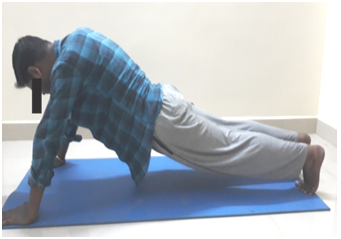
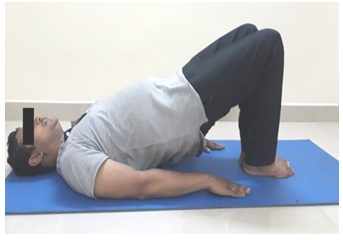
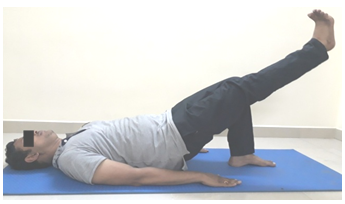
Single leg hip extension: The patient was asked to lie down on his back with his knee bent at 90 degree and his feet hip width apart. From this position patient was asked to raise the leg and hold it suspended. Then the patient was asked to push his hips and lower back as one unit through the stabilizing leg, keeping his weight centered at his heel.10 repetitions with 10 counts hold

Seated knee extension: Subjects was in high sitting position, and the patient was asked to straight the knee.10 repetition with 10 count hold

Straight leg raise (SLR): The non-affected leg was flexed for 90 degree at the knee joint; the affected lower limb is straight on the table. The patient was asked to raise the affected lower limb straight to the level of the other leg.10 repetitions with 10 count hold.

Procedure of intervention for control group

Each participant in this group received ultrasound therapy with the intensity ranging from 0.8 -2 W/cm2 for 8 minutes in pulsed mode. The subject was positioned in high sitting position with the knee slightly rotated outward and the other leg of the subject was asked to keep apart from the involved limb.  The ultrasound was given by the therapist over the painful area in small concentric circles.33

Method for outcome measures

Visual Analogue Scale (VAS): VAS was used to measure subjects perception level of pain due to Pes anserine bursitis .It consists of scale where scoring is from 0-10. With score 0 subjects express no pain and with score 10 expresses maximum pain. The patient was asked to level the highest amount of pain they were getting at the time of assessment.

Knee Range of Motion (ROM)-Goniometry: Knee ROM includes flexion and extension which was measured by goniometer. To measure knee flexion, patient was asked to lie down in supine position and the subject was asked to bend the knee. Three trials of the same procedure were performed and average of the readings was considered for data analysis. To measure Knee extension, the patient was asked to lie down in prone position. The subjects was instructed to lift the knee without pelvic tilt (stabilize femur) and then goniometer was placed and the average reading of the three trials was recorded.

Inclusion criteria: Subjects between ages of 15-30 yrs. Both genders were included. History of improper training, running up hills with trackers, which produce pain and tenderness localized near Pes anserine bursa, Marathon runners, running for > 2 years were selected for the study.

Exclusion Criteria: Subjects with stress fracture, subjects with other lower limb musculoskeletal pathology, subjects with ischemic disorder of lower limb, subjects with muscle spasm of hip extensors, malignancies or tissue damaged by radiation therapy, subjects with visual impairment   or  with  any   other  neurological

disability like any head trauma, dementia, learning disorder and schizophrenia, and Osteoarthritis of knee were excluded from the study.

Materials and Methods: It includedCouch, EMS/Galvanic, Dexamethasone sodium phosphate aqueous solution, Cotton, Microspore tape, Goniometer, Ultrasound machine, and Aquous gel

Outcome Measures: Visual analogue scale (VAS) and Knee range of motion (ROM) goniometry

RESULT

Study design: A Comparative two group interventional clinical study

Table 1: Age distribution of patients studied, P=0.909, Not Significant, Student t test

Table 1 show that there is 46.7% of patient in Experimental group and 40% in Control group of age group 15-20. However, 53.3% were in

experimental group and 60% in control group of age group 21-30. 

Table 2: Gender distribution of patients studied, P=0.713, Not Significant, Chi-Square Test

In table 2, Experimental group consists of 60% female and 40% male whereas control group consists of 53.3% female and 46.7% male patients. Overall, 56.7% of patient was females and 43.3 % was males.

Table 3: VAS Score-A Comparative assessment at pre and post in two groups of patients studied

VAS score of both the group were analysed in table 3 and the mean difference in percentage was obtained. Range of VAS scale score was made as 0, 1-3, 4-6, 7-10 in both the groups. The VAS score has been significantly reduced in Experimental Group as compared to Control Group. In the VAS score the % difference between the pre and post treatment is 46.7%, 53.3%, 0% and -100%.

Table 4: Knee ROM- A Comparative assessment at pre and post in two groups of patients studied

In table 4, Knee ROM has been ranged as 50-80, 80-100,100-120,120-135 degree. The % difference between pre and post treatment is -73.3%,-26.7%, 66.7%, and 33.3% which shows the high significance of the treatment in Experimental Group. The P value is of <0.001** resulting highly significant. In control Group, the KROM in day 14 is 60%, 33.3%, 6.7%, 0% respectively for the given ROM range which indicates that there is very less improvement in KROM  after treatment. The mean difference is not as high as that of experimental Group which is -13%, 6.6%, 6.7% and 0.0% respectively for the given range.

Table 5: A Comparative assessment of VAS and Knee ROM at pre and post in two groups of patients studied

In table 5, VAS score of the patient in EC was 8.27±0.80 whereas post treatment in day 14 it became 0.67±0.72. The mean difference noted is 7.600 and the p value is highly significant at <0.001**. Similarly for control group, VAS score in day 1 is 7.80±0.94 and for day 14 is 4.40±0.83. There is not much difference between pre and post score for VAS in control group, which is just 3.400.

Knee ROM for EC in day 1 was 69.67±14.82 whereas in day 14 it is 119.67±6.67.The mean difference between pre and post treatment score is of -50.000 and the P value at <0.001**. However, control group doesn’t depict much change after treatment. The mean difference between Pre and Post treatment score is just -13.333, far less than that we achieved in EC.

Table 6: Comparison of difference of VAS and Knee ROM in two groups of patients studied

Table 6 displays the difference in VAS and Knee ROM of patients of. Experimental group and control group. Difference in VAS score is 5.50±2.42 and Knee ROM is 31.67±22.18.

DISCUSSION

The purpose of the study was to find the effectiveness of iontophoresis with open kinematic chain exercises to reduce pain and to increase knee ROM in sports person with pes anserine bursitis. The study consists of 30 sports persons diagnosed with Pes Anserine bursitis.15 subjects were kept in experimental group and other 15 in control group. The subjects in experimental group received iontophoresis with open kinematic chain exercises of knee and the control group was treated with ultrasound only. In this study, experimental group and control group result were analysed using student t test and chi square test.

Result obtained from this present study shows that when the mean reduction values of VAS and ROM were analyzed within the groups, it was statistically significant in both the groups for VAS score whereas there was no any effect in KROM in control group. Iontophoresis along with open kinematic chain exercises was found to be very effective in reducing pain and improving ROM. VAS score assessment for pain showed significant improvement in both the groups after the treatment.

This statement is supported by Robert et al (2003) where they concluded that iontophoresis administration of Dexa-methasone sodium phosphate is well tolerated by the patients and is able to reduce pain.The statement is further supported by Linda C et al (1995) where dexa-methasone sodium phosphate was used to treat rheumatic arthritis and the result obtained showed that iontophoresis treatment was more effective in reducing pain and improving ROM. The dexamethasone sodium phosphate delivered via iontophoresis penetrates deep into the joint and thus reduces the symptoms 9.

Iontophoresis is the most commonly used method for pain and inflammation. Iontophoresis for treatment of locomotor system lesions should be considered as an alternative to peri and intra-articular injections because the drugs used diffuse to the tissues along the dermal barrier and penetrate into the body and thereby reduces the symptoms more effectively.Iontophoresis administration of dexa-methasone sodium phosphate was more effective in reducing the pain and other symptoms in short term follow up for patients with lateral Epicondylitis.

Although ultrasound was found to be reducing pain and increase the healing process, the result obtained from this study was not as highly significant as in experimental group. Therefore all the above literature supports the efficacy of iontophoresis in reducing the pain and allowing the better tolerance for exercises.The study was designed to find the effectiveness of iontophresis and open kinematic chain exercises   to reduce pain and to improve KROM in sports person with Pes anserine Bursitis.

This study was a randomised experimental study where 30 sports person with Pes anserine bursitis of age group 15-30 wereselected.The subjects were evaluated and included for the study using inclusion criteria such as VAS score 6-9, both the gender and tenderness over the pes anserine bursa. Subject with recent surgery in and around the knee, stress fracture, and other progressive neurological deficit were excluded. Subjects who were willing to participate in the study were requested to fill the consent form.

On day one, pre- treatment baseline assessment was done using VAS for pain assessment and knee ROM by using goniometer.30 Subjects were assigned to either group of 15 in each group. That is experimental group (EG) which received iontophoresis and OKC exercises and control group (CG) which received ultrasound therapy. Post treatment assessment was done on 12th day of treatment using VAS and by measuring KROM using goniometer. Data were analysed using Paired –“t” test and Un-paired “t” test. The result shows that there is reduction of pain and improvement in KROM after 12 days of intervention in EG when it is compared to CG.

Therefore the study concludes that the iontophoresis and open kinematic chain exercises are an effective intervention to reduce pain and to increase KROM in sports person with Pes Anserine bursitis after the 12 days of treatment. The analysis found the highly significant differences in between the pre and post test score of KROM for experimental group. This statement is supported by M Seshagirirao et al (2016) which concluded that open kinematic chain exercises are effective in improving the strength and knee function 10.

Graham et al (1993)found that Open kinematic chain exercises are helpful in improving range of motion and strength of quadriceps and hamstrings muscles. This statement is further supported by the study William E Prentice (2003) who observed that open kinematic chain exercises are helpful to gain strength, flexibility and endurance of hamstrings muscles group in sports person affected with Pes Anserine bursitis.  Open kinematic chain exercises of knee were studied and the result obtained showed significant improvement in the hamstrings strength and ROM. Therefore all the above literature supports the efficacy of iontophoresis and open kinematic chain exercises in reducing pain and improving knee ROM in sports person with Pes anserine bursitis11.

As Pes anserine bursitis is considered as a self- limiting disorder, in some cases it is not possible to determine if this self-limiting factor led to the improvement of pain levels and knee ROM instead of treatment administered. The sample size is small and the treatment duration is for short period of time. In future, further studies can be done on larger sample size and for long duration. Additionally, further studies can be done which involves treatment programs like iontophoresis and close kinematic chain exercises.

Ethical Clearance: Ethical clearance has obtained from Institute of Neuroscience, Kolkata to conduct this study with reference number: 214/ Research/IRB/2018-19dated 24/09/2019.

Conflicts of Interest: The author declares that there is no competing interest in publishing this article.

Fund for the study: This is self-funded study.

CONCLUSION

This study concluded that the experimental group which received iontophoresis along with open kinematic chain exercises demonstrated   good effect in reducing pain and increasing Knee ROM.  But when the experimental groups is compared with the control group which received only ultrasound therapy, EG showed significant improvement in VAS and KROM score whereas there is not much significant improvement in outcome measures post treatment in control group.

REFERENCE

  1. Miller RH III. (1998)Knee injuries. In: Canale ST, ed. Campbell s operative orthopaedics. St Louis: Mosby; 1113–1299. .
  2. Pompan DC. (2016). Pes Anserine Bursitis: An Underdiagnosed Cause of Knee Pain in Overweight Women. Am Fam Physician.  Feb 01; 93(3):170. 
  3. MSeshagiriRao et al. (2016). Effectiveness of open kinematic chain exercises versus closed kinematic chain exercises of knee in meniscal instability athletics. International Journal of Physiotherapy and Research 4(1):1345-1351 · 
  4. McMorrisy and perry et al, (2005). Effect of open vs close kinematic chain exercises in extensor resistance training in knee injury patient.
  5. Sim J, Waterfield J. Validity, (1997). Reliability and responsiveness in the assessment of pain. Physiotherapy theory and Practice; 13: 23-27.
  6. Revill S, Robinson J, Ronsen M and Hogg M. (1976).The reliability of a linear analogue for evaluating pain.Anaes; 31:1191-1198.
  7. Gogia PP, Braatz JH, Rose SJ, Norton BJ. (1987). Reliability and validity of goniometric measurements at the knee.  67(2):192-5.
  8. Escamilla RF,Fleising GS, Zheng N, Barrentine SW, Wilk KE, Andrews J R. (1998). Medsci sports exercises apr 30; (4).
  9. Lysholm J, Gillquist J. (1982). Evaluation of knee ligament surgery results with special emphasis on use of a scoring scale. Am J Sports Med 3; (10): 150-4.
  10. Neeter C, Thomee R, Silbernager KG, et al. (2003). Iontophoresis with or without dexamethasone in the treatment of acutachilles tendon pain. Scand J Med Sci Sports; 3:376-382.
Citation:   Gummadi Ashish (2021). A study to find the effectiveness of iontophoresis with open kinematic chain exercises in Pes Anserine bursitis in sports persons, ijmaes; 7 (1); 916-926.

A study to find out the prevalence and characteristics of low back ache among caregivers of adults with spinal cord injury

Gummadi Ashish

Senior Physical therapist, Department of Neuo-rehabilitation, Institute of Neurosciences, Kolkata,

Mail id: ashishgummadi@gmail.com

ABSTRACT

Back ground: Back pain is common among health workers especially patient’s caregivers in Spinal Cord Injury group. Objectives of the study were to estimate the prevalence of low back pain among the caregivers of adults with spinal cord injury. Care givers of all the spinal cord injured individuals who seeks for rehabilitation in the department of PMR were eligible to participate in the study.

Methodology: This was an observational study with a cross-sectional study design. After receiving the consent, the participants were asked to fill the questionnaire. First part of the questionnaire consists of demographical data of the patients and their caregivers. If the caregiver was reporting LBP, then they were asked to grade their pain intensity through Visual Analogue scale and also to fill Oswestry Disability Index (ODI) to identify the disability caused by the LBP. These data were used to find the prevalence of LBP among caregivers and also to find relationship with various demographical variables.

Results: One hundred patients and their caregivers’ data collected and analyzed. Out of these 20 where drop outs and samples female (42) caregivers reported that they have low back pain. In that 16 caregivers were males and 26 were females. There was no statistically significant difference between the patients and caregivers of the LBA group and no pain group in the demographic data except the duration of injury.

Conclusion: This study aimed to find out the prevalence and characteristics of low back ache of caregivers of the adult with low back pain. Study revealed 51.9% prevalence of low back pain among the SCI caregivers.

Key words: Low back pain, Caregiver, Spinal cord injury

Received on 11th September 2020, Revised on 12th October 2020, Accepted on 10th November 2020 DOI:10.36678/IJMAES.2020.V06I04.001

INTRODUCTION

Low back pain (LBP) is a common problem affecting most of the adults’ population at some point during their lifetime, especially in low and middle income countries 1, 2.  In a report of the World Health Organization (WHO) in 2003, it was found that about 80% of people have LBP at some time in their life 3. Quality of life, burden, satisfaction, and depression of caregivers have been extensively studied. Back pain is the most frequent cause of activity limitation in people below 45 years according to (NIH) guidelines4

Risk factors associated with LBP in the workplace have also been studied, particularly in occupations such as nursing, industrial work, police service, and fire service 5, 6. Lifting heavy objects, inappropriate lifting techniques and poor fitness levels are risk factors among nurses, whereas heavy physical activity, frequent bending and lifting, repetitive movements, being exposed to vibration, and depression are significant risk factors among industrial workers 7-10.

After the Traumatic or Non- Traumatic injury the individual becomes spinal cord injury there is of the need for assistance in their daily living activities. This might be assistance in feeding, bathing dressing shifting to uneven surfaces or even surfaces toileting or dressing. Today with the change in health care, we see more family members as the source of care support more than 40% of spinal cord injured individuals use some assistance or the other with their family members females are more likely to have a paid attendant as caregiver, while male have their parent assist.

Manual patients transfer tasks between bed wheel chair and bath cart, perceived physical exertion were consistently associated with different measure of LBP. The symptoms of low back pain are notice with flexion of the back, and when lifting the heavy objects. Patients handling was found to be an extremely hazardous job that had substantial risk of causing a low back injury whether with one or two patient handlers. Prevalence of LBP was significantly higher among caregivers (58%) compared with age- and BMI-matched controls (27.6%). The prevalence of LBP was also higher among caregivers of SCI patients with long duration of injury; i.e. LBP was associated with care-giving duration11.

Objectives of the study: Objectives of the study were to know the prevalence of low back pain among the caregivers of adults with spinal cord injury and to find the disability caused by low back pain in caregivers of adults with spinal cord injury.

METHODOLOGY

Care givers of all the spinal cord injured individuals who seeks for rehabilitation in the     department of PMR are eligible to participate in the study. After receiving the consent, the participants were asked to fill the questionnaire. First part of the questionnaire consists of demographical data of the patients and caregivers. If the caregiver is reporting LBP, then they will be asked to grade their pain intensity through Visual Analogue scale and also to fill Oswestry Disability Index (ODI) to identify the disability caused by the LBP.

This study design  was observational study and the study setting done at Urban and rural population around the outskirts of Bangalore. 100 subjects were taken for the study and Simple Random Sampling method used to allocate the subjects in different group. Subjects aged between 25 to 50 years of both sexes from urban and rural areas of Bangalore. The study conducted for duration of 10 months.

Selection criteria

Inclusion Criteria: age- 25-50yrs, both male and female subjects, Subjects with spinal cord injury, subjects with six months post injury, subjects attending for more than 4 hours.

Exclusion Criteria: Previous history of back pain irrelevant to care –giving, Caregivers who have history of back surgery, Caregivers who have a history of back fracture, Caregivers with physical disability

Outcome Measure: Demographic variables, Pain, Neck Function

Measurement Tools: Demographic Questionnaire, Oswestry Disability Index–short form (ODI) and  VAS scales.

Procedure for Intervention: As the questionnaire is being filled and returned by the subjects, the data were analyzed to find outcome and significant differences in assessment of risk of low back pain in caregivers with spinal cord injury patients.

Figure 1. Assessment of ODI Scale with Patient

Figure 2. Transferring Techniques for Caregivers

RESULT

Table 1:Demographicdataofgenders
Table 2: Duration of care in relation to gender
Table 3: Average time spend with patient according to gender
Table 4: Duration of care and average time spend on patient with neck and back pain
Table 5: Duration of care and average time spend with patient in relation to VAS and ODI
Graph: 1 Graphical representation of duration of care and average time spend with patient in relation to VAS and ODI

One hundred patients and their caregivers’ data collected and analyzed. Out of these 20 where drop outs and samples female (42) caregivers reported that they have low back pain. In that 16 caregivers were males and 26 were females. There was no statistically significant difference between the patients and caregivers of the LBA group and no pain group in the demographic data except the duration of injury.

DISCUSSION

In the present study, prevalence of LBA was found to be 51.9%. Our results are similar to the study reported by Barak et al among Turkies people and they reported 54%.

The prevalence was also higher among the caregivers of SCI patients with long duration injury; i.e. LBA was associated with care giving duration. This was attributed to activities that cause LBA having carried out for long time. ASIA impairment scale was used to evaluate the patient’s level of injury and the assistance of caregivers required in their mobility LBA 12.

SCIM scores were not associated with caregivers’ LBA.  As there are no mechanical devices available in India to transfer a patient, manual handling is common. The availability of man power in a home set up also an issue. A high frequency of LBA among caregivers with low ASIA score was thus an expected result. The use of mechanical patient lift systems is advantageous in reducing the load on the back and healthcare workers are recommended to use these systems 13, 14.

They also found that LBP was more common among caregivers of patients with motor complete lesion identified according to the American spinal injury impairment scale (AIS). transfer and locomotion of the patients nursed by caregivers with LBP were significantly lower than those of patients nursed by caregivers without LBP15 .

LBP causes a large financial burden on individuals, families, communities, industry and governments including the costs of medical care, compensation payment, productivity loss, employee retraining, administrative expenses and litigation 16.

Low back pain (LBP) is well recognized to be an enormous general health problem and is the leading cause of activity limitation throughout much of the world. LBP is a major problem all over the world, especially in low and middle income countries 17.

Ethical clearance:

Ethical Clearance: Ethical clearance has obtained from Hosmat College of Physiotherapy and Research Institute, Bangalore to conduct this study with reference number: 33/PHSIO/IRB/2018-19dated 07/06/2018.

Conflicts of Interest

The author declares that there is no competing interest in publishing this article.

Fund for the study: This is self-funded study.

CONCLUSION                                                                               

This study aimed to find out the prevalence and characteristics of low back ache of caregivers of the adult with low back pain. Study revealed 51.9% prevalence of low back pain among the SCI caregivers. Duration of injury was the key factor for the occurrence of low back pain. 

REFERENCES

  1. Dunn KM, Croft PR. (2004). Epidemiology and natural history of low back pain. Eura Medicophys., 40(1): 9-13.
  2. Tong HC, Haig AJ, Nelson VS, Yamakawa KS, Kandala G, Shin KY. (2003). Low back pain in adult female caregivers of children with physical disabilities. Arch Pediatr Adolesc.; 157:1128-1133.
  3. Feng CK, Chen ML, Mao I F. (2007). Prevalence of and risk factors for different measures of low back pain among female nursing aides in Taiwanese nursing homes. BMC Musculo skelet Disord; 8: 52.            
  4. Bardak a, Erhan and Gündüz (2012). Low back pain among caregivers of spinal cord injured patients j rehabil med.; 44: 858-861.
  5. Ebru Yilmaz Yalcinkaya, et al. (2007). A Pilot Study Low Back Pain Prevalence and Characteristics in Caregivers of Stroke Patients, 17(5): 389-393.
  6. Tong HC, HaigAJ, NelsonVS, YamakawaKS, KandalaG, ShinKY (2003). Low back pain in adults’ female caregivers of children with physical disabilities. Arcives of pediatric and Adolescence Medicine; 157(11):1128-33.
  7. TomoikaK, KumagaiS, HiguchiY, TsujimuraH, AraiY, Yoshida J. (2007). Low back load and satisfaction rating of caregivers and care receivers in bathing assistance given in nursing home for the elderly practicing individual care) Sangyo Eiseigaku Zasshi;  49(2); 54-58.
  8. Majim Y, HorikikawaJ, ShonoI, (2004). Study on the Lower back pain in home helper’s and. Development of materials for occupational health education). 1; 26(1); 59-74.
  9. Brown AR, Mulley G P (1997). Injuries sustained by caregivers of disabled elderly people. Age Ageing; 26(1); 21-23.
  10. MarrasWS, Davis KG, Kriking BC, Bertsche PK. (1999). A Comprehensive analysis of low back disorders risk and spinal loading during the transferring and repositioning of patients using different techniques, Ergonomicsn ; 42(7);904-926.
  11. TomoikaK, KumagaiS, HiguchiY, TsujimuraH, AraiY, Yoshida J. (2007).Low back load and satisfaction rating of caregivers and care receivers in bathing assistance given in nursing home for the elderly practicing individual care.)Sangyo Eiseigaku Zasshi , 49(2); 54-58.
  12. SchibyeB, Hansen AF, Hye-Knudsen CT, (2003). Biomechanical analysis of the effect    of  changing patient-handling technique. Appl Ergon; 34(2):115-123.
  13. FrangalaG, FragalaM, Pontani-Baily L. Proper positioning of clients: a risk for caregivers.) AAOHN J .2005Octuber; 53(10); 438-442.
  14.  Davidson M & Keating J (2001). A comparison of five low back disability      questionnaires: reliability and responsiveness. Physical Therapy; 82:8-24.
  15. Joshua Israel Vincent, Joy Christine Mac Dermid Ruby Grewa, Vincent     Prabhakaran Sekarand Dinesh Balachandran, (2014). Translation of Oswestry Disability Index into Tamil with Cross Cultural Adaptation and Evaluation of Reliability and Validity, Orthopaedics Journal, 8, 11-19.
  16. Matthew O.B. Olaogun, Rufus A. Adedoyin, Innocent C. Ikem & Olubusayo R. Anifaloba  Physiotherapy Theory and Practice, Volume 20, 2004-Issue 2; 10 Jul 2009.
  17. Craig CL, Marshall AL, et al. (2003). International physical activity questionnaire: 12-Country reliability and validity. Medicine and Science in Sports and Exercise, 35(8):1381-395. 

Citation:

Gummadi Ashish (2020). A study to find out the prevalence and characteristics of low back ache among caregivers of adults with spinal cord injury, ijmaes; 6 (4); 829-835.

The changes of functional disability in non-specific low back pain among University population after proprioceptive neuromuscular facilitation and Mckenzie method

Lucky Anggiat1, Wan Hazmy Che Hon2, Siti Nur Baait binti Mohd Sokran3, Nurul Mawaddah Binti Mohammad3
Author:
1Faculty of Vocational Studies, Physiotherapy Program, Universitas Kristen Indonesia, Jakarta, Indonesia
3School of Health Sciences, KPJ Healthcare University College, Nilai, Malaysia
Corresponding Author:
2Consultant Orthopaedic Surgeon, KPJ Seremban Specialist Hospital and KPJ Healthcare University College, Jalan Toman 1, Kemayan Square, 70200 Seremban. Email address: whazmy@hotmail.com

ABSTRACT

Background of study: Non-specific low back pain (LBP) becomes the most common cases in University population. Prolonged sitting has been identified as one of the factors leading to non-specific LBP among University population. The purpose of the study is to identify the change of functional disability in non-specific LBP among university population after PNF and McKenzie method.

Methods:  A quasi-experimental study involving 36 subjects (students and office workers) from the university population. The study population were selected from students and office worker of KPJ Healthcare University College (KPJUC) who met the inclusion criteria. The subjects were divided into three treatment groups: PNF group, McKenzie group and control group (hot pack and educational home exercise sheet) which underwent 12 treatment sessions distributed over three times in a week for four weeks duration. Subjects were measured on functional disability by Oswestry Disability Index (ODI). Measurement was performed at pre-test, mid-test and post-test. Repeated measures ANOVA was used to analyse the effectiveness of PNF and McKenzie treatments based on the measurement time.

Result: This study showed that the PNF and McKenzie gave effect in improving ODI score in within group analysis. However, the results of PNF showed that it has more effect than McKenzie method on functional disability score (p <0.05) after 4 weeks. 

Conclusion: There was a change in functional disability on non-specific LBP after PNF and McKenzie method. Furthermore, the study findings showed that the PNF exercise has more effect in improving functional disability compared to McKenzie method on non-specific LBP among university population.

Keywords: Functional Disability; Mckenzie; Non-Specific LBP; PNF

Received on 10th February  2020, Revised on 19th February  2020, Accepted on 24th February 2020

DOI:10.36678/ijmaes.2020.v06i01.001

INTRODUCTION

Low back pain (LBP) consists of two types, which is specific and non-specific LBP. Specific back pain can further be divided into LBP which that is related with vertebrae and non-vertebrae. The non-specific LBP is developed from the soft tissue, which is poorly localised 1. In addition, non-specific LBP is further classified into LBP, which is not related to the neurological problem and degenerative syndrome. Prolonged sitting led to increased body discomfortness in the neck, shoulder, upper back, low back, and buttock while prolonged slumped sitting may be related to Internal Oblique or Transverse Abdominis muscle fatigues—compromising the stability of the spine, making it vulnerable to injury 2.

University population mainly consists of students, office workers and academicians, which have similar habit to experience prolonged sitting. Students usually attend the classroom session for learning theories and at the same time working in front of computer to browse some resources. They experience prolonged sitting in most of their daily activities. A previous study conducted by Nordin, Devinder, and Kanglun reported 31% of students usually sat in the classroom or worked daily in front of the computers everyday for 6 to 8 hours 3.

Similarly, majority of the office workers working in the university, sit more than 4 hours daily with 90.8% prevalence while other office workers who sit in the same working position usually leave their office chair only for 10 minutes or less each day have scored about 65.8% prevalence. Prolonged sitting is one of the factors causing musculoskeletal pain among university population, which are student and office worker, who experienced from having LBP (LBP), which commonly reported 4.

A study conducted by University in Columbia found that 45% of the university population were having severe chronic pain specifically in the lower back region. A study by Nordin, Devinder, and Kanglun; also revealed similar results which stated that 64.6% of students had LBP and it was found that the students also sat in the classroom or worked in front of the computers everyday between 6 to 8 hours 5,6.

Some anatomical condition related to those factors can be contributed to the incidence of LBP. Low back pain may developed by some factors which increase lumbar lordosis, reduce abdominal muscle length and strength, and decrease back extensor muscle endurance, back extensor muscle flexibility, length of iliopsoas, hamstring muscle flexibility, body composition and others 7,8.

A study by Casas et al. found that the prevalence of limitation for academic activities was almost 30% and it affected to both office workers and students on their daily life activities. It caused potential effects to the life quality of both the office workers and the students. The limitation in academic activities due to pain was 29.8%. The researchers concluded that there was moderate disability due to LBP among physiotherapy students in Mumbai 9.

The similar potential risk happened to office workers who were suffering from LBP. An employee with LBP usually took a day off from his work for medical check-up would decrease the company’s productivity if it had a significant number of employees who were absent from work due to having LBP. The impact of LBP on physical activities does not only depend on the pain but also on some functional disability, which is inter-related one to another 10,11.

There are several options and suggestions on the treatment to reduce LBP in the population . Exercise is also one of the physiotherapy treatments that can strengthen the muscle that supports the spine 12,13.  

Theraphy exercise was found to be the best choice to reduce LBP and to increase body functions in adult people who experienced LBP. The therapeutic exercise for LBP uncommonly performed by physiotherapist called Proprioceptive Neuromuscular Facilitation (PNF), however; this treatment is commonly used for neurological conditions 16,17.

PNF has been recommended for sensory-motor control training, as well as for stimulating lumbar muscle proprioception. Kofotolis and Kellis stated in their study that PNF significantly improve the muscle endurances. They defined that the Rhytmical Stabilization (RS) exercise provided  the trunk static endurance and Combination of Isotonic (COI) provided dynamic muscle endurance 18,19.

 In other studies, in comparing modalities of therapy exercises, PNF was shown to have better result than manual therapy, core stability exercise and ball exercise for LBP which was commonly used for the trunk muscle, pelvic stability, and core muscle 20, 21.

A common therapy exercise used for LBP was developed by Brian McKenzie, which was recognised as McKenzie method. A systematic review study has shown that McKenzie therapy is more effective than the comparred treatment at short-term follow up for spinal pain. The comparative treatments in these trials include Non-Steroid Anti Inflammation Drugs (NSAIDs), educational booklet, back massage with back care advice, strength training and spinal mobilization and general mobility exercises. McKenzie method can be a familiar treatment and it is one of the common choices used by most physiotherapists for treating LBP 22,23.

There were several studies that performed the specific exercises to treat LBP, such as McKenzie method, PNF, ball exercise, yoga, spinal stabilization exercise, Mat based Pilates and ordinary exercise that is aerobic exercise which is effective and it has a good result for LBP. However, these previous studies did not conduct any comparison between PNF exercise and McKenzie method to verify the effect of each treatment. Therefore, this study carried out the changes of functional disability among university population after the PNF exercise and McKenzie method and specifically comparing the effects of those treatments 24,25.

METHODOLOGY

This was an experimental study using quasi-experimental study. Quasi-experimental study is defined as study comparing the effect and value of intervention in between three groups at their pre-test, mid-test and post-test design in which subjects are equally differentiated on the treatment given and on the control group. All subjects that included in this study were assigned to three groups. Upon selection, subjects were given written and verbal study information and informed consent, which states that they are willing to be the subject of this research. Informed concent received from all subjects then physiotherapist assessed the subject based on the measurements called disability score using Oswestry Disability Index (ODI). In addition, the information about age, gender, occupation and years of working or studying were collected and presented as socio-demographic data of the subjects.

The three groups of subjects, who had been managed with PNF exercise, McKenzie method and control group respectively, were compared. The assessment point was performed at three points; pre-test as the baseline measurement, mid-test was given two weeks after treatment and post-test as the last measurement after four weeks treatment. The subjects had to undergo 12 sessions of treatment, 3 sessions in each week of four-week-treatment. This study was conducted in a private academic institute and the ethical approval has be obtained from School of Health Sciences, Research Management Centre, KPJ Healthcare University College (KPJUC), in Nilai, Negeri Sembilan, Malaysia before starting the study.

The inclusion criteria were the subjectssuffering from chronic non-specific LBP. Chronic non-specific low back pain was determined based on the subjects’ report. The physiotherapist conducted the assessment to make sure the low back pain was non-specific in nature 3, 4. All subjects were also asked about their duration of sitting in a typical working day because prolonged sitting is one of the contributing factors for non-specific low back pain with age ≥ 18 to 45 years old 26, 27.

 Participants were excluded in this study according to the exclusion criteria, which are subjects with any history of pathological conditions or diagnosed with disk herniation, spinal stenosis, spondylolisthesis, spondylitis, radiculopathy, vertebral fracture, surgery to lumbar spine, reported with pregnancy and reported with other medical illnesses such as tumour, kidney disease, and visceral disease 28.

The subjects were 36 subjects and the office workers

of KPJUC who met the selection criteria prior to sample screening. The determination of the sample size was done using G*power 3. The three groups used F test, the effect size f was 0.25 and power was 0.8. Based on the data, the calculated total sample size is thirty and as additional subject is 20% from total sample size, which is six and therefore, the total sample size were thirty-six with twelve subjects for each group. The sample size was determined based on a previous study.The timing for the implement-tation of data collection and testing of the research subjects was from August 2017, December 2017.

Three of the physiotherapists participating in this study were trained by the principal physiotherapist to perform the specific PNF exercise and McKenzie method used as experimental treatment in this study. The training includedwith visual demonstrations, hands-on experience and technique evaluation. The training was continued until all physiotherapists had successfully mastered each technique. Physiotherapists performing the PNF exercise and McKenzie method reached the training criteria within two-week period. In addition, these three physiotherapists were closely supervised by the principal physiotherapist in charge in KPJUC Rehab Centre to assure proper performance of PNF exercise and McKenzie method for the techniques and the assessment of the subjects.

Measuring Tools: The Oswestry Disability Index (ODI) was used to assess the subject’s disability that caused by the non-specific LBP. The questionnaire contains 10 sections, with six statements for each section. The questionnaire can be self-administered by the patient or assessed by the physiotherapist; it is usually completed in less than five minutes and scored in less than one minute 29.

Each subject was asked to select one statement in each section of the questionnaire which best represents his or her perceived ability to perform a function and a quantity of pain experienced on the assessment day. Each statement is scored on a 6-point scale (0-5), where a score of “0” is awarded if the client selects the first statement of the section and a score of “5” is awarded if the client selects the last statement. The section scores are tallied to produce a total raw score. Total raw scores can vary from 0 to 50 and the percentage ranges from 0-100 30.

Intervention Procedures: Subjects in the group I received the PNF exercise intervention. The PNF technique was performed on the trunk movement. The patient was in a sitting position. First, the physiotherapist conducted the Rhythmic Stabilisation (RS). The RS exercise consisted of alternating (trunk flexion-extension) isometric contractions against resistance for 10 seconds, with no motion intended. The subjects performed three sets of 10 repetitions at maximal resistance provided by the same physiotherapist. The resting intervals of 30 seconds and 60 seconds were provided after the completion of 10 repetitions for each pattern and between sets, respectively. Secondly, the physiotherapist conducted combination of isotonic technique with flexion or extension for lumbar, depending on the patient condition. The combination of isotonic technique consists of alternating concentric and eccentric contractions of agonists without relaxation. The resisted active concentric contraction for 5 seconds, resisted eccentric contraction for 5 seconds, and resisted maintained during contraction for 5 seconds (trunk flexion-extension). The combination of isotonic performed three set of 10 repetitions with resting intervals of 30 second and 60 second were provided after completion of 10 repetitions for each pattern and between sets, respectively. Then, all PNF exercises will be held for 30-45 minutes 31.

The subjects in the group II received the McKenzie method treatment. The physiotherapist guided the subject to conduct four extension exercises and three flexion exercises. The extension exercise started with these following stages. Firstly, the subjects laid their face down for one until two minutes. Secondly, they laid their faces down with extension. The subject were  asked to start laying their faces into down position followed by the extension of the trunk on the elbow and held on for five seconds and went back to the first position as a relaxation. Thirdly, extension on lying, the subjects were instructed to start lying their faces into down position, followed by the extension of the trunk with elbow extension (push-up position) for ten seconds, then the subject were asked to relax by going back to the first position. Forthly, extension on standing, the subjects were instructed to get standing position and then they were asked to do the extension of the trunk and to hold for five seconds with hands of the back and the fingers pointing backwards, followed by a relaxation by going back to the standing position. All extension exercise were repeated for ten repetitions in two sets.

The flexion exercise was started by these following steps. Firstly, flexion on lying, the subjects wereasked to get a lying position and asked to flex the trunk with both knees to the chest and to hold with both hands. Subjects were instructed to hold that position for five seconds and get a relaxation by going back to the first lying position. Secondly, flexion on sitting, the subject were asked to sit on the edge of a chair and instructed to bend the trunk forward and to grasp the ankle or to touch the floor with both hands. This position was maintained for five seconds and it was followed by a relaxation to the first position. Thirdly, flexion on standing, the subjects wereasked to get a standing position, then instructed to bend forward or to flex the trunk with fingers down to the legs as far as the subjects comfortably reach them. The subjects wereasked to hold on the last position for five seconds and asked to go back to a standing position as a relaxation. Then, all flexion exercise was also repeated for ten repetitions in two sets. There were three minutes for resting intervals in every set. The McKenzie treatment lasted for 20-40 minutes 30.

The subjects in the group III were treated using hot pack for 15 minutes as a basic treatment for non-specific LBP. The physiotherapist gave them some home exercises guided by educational exercise sheet and teach the subjects how to use it. A narrative review, written by Bardin, King and Maher , revealed that a hot pack considered as the first line of care for non-specific LBP along with self-management with home exercise. The exercise based on the educational exercise sheet lasted for 7-10 minutes that can be done at home or the office. All of the subject in each group underwent 12 sessions of treatment, 3 sessions in each week of a four-week-treatment.

Data analysis: All data analysed were performed by using IBM SPSS Statistics for Windows, Version 22.0. Repeated measures ANOVA analysis were used to determine the result of differences before and after treatment given in every group. Repeated measure ANOVA within-between groups analysis were applied to determine the effect between three treatment groups based on time measurement. Bonferroni adjustment were applied for multiple comparison.

RESULT

The total number of subjects of 36 was divided into 3 treatment groups, and each group consisted of 12 subjects. Most of the participants were 18-25 year-old subjects (75%), female (63.9%), and students (61.1%) who had been studying or working for 1-3 years (75%). The socio-demographic details such as age, gender and occupation are tabulated in Table 1.

 Table 1. Socio-demographic distribution of the subjects (n=36)

Table 2 described the within group result of PNF exercise, McKenzie and Control group using Oswestry Disability Index (ODI) in terms of Mean Difference (MD) and Confidence Interval (CI). There was a significant effect of time on ODI F = 97.91, p = 0.001.

Table 2. Comparison of Oswestry Disability Index (ODI) for each treatment group based on time (n=36)

Table 3 below describes between group result of PNF exercise, McKenzie and Control group in Oswestry Disability Index (ODI) in terms of Mean Difference (MD) and Confidence Interval (CI). There was significant difference of ODI score between the group (F= 6.19, p = 0.005).

Table 3. Overall mean difference of ODI among three treatment group based on treatment effect) (n=36)

Table 4 describe the comparison between PNF exercise with Control group, McKenzie method and Control group treatment on ODI in terms of Mean difference and p-value for every comparison group. The Multivariate test for ODI-treatment interaction result based on F-test showed the p < 0.005.

Table 4. Comparison of ODI among three treatment group based on time

DISCUSSION      

The findings of the present study showed that there was a good improvement in functional disability that was assessed by using Oswestry Disability Index (ODI) in within group analysis. Those three treatments showed significant result in reducing the ODI score after treatments both after 2 weeks and after 4 weeks. This implied that all the three treatments were successful in reducing the ODI score. In between groups and time-treatment interaction, showed there was significant difference result in increasing ODI score by PNF than control group treatment after 2 weeks of treatment, however, comparison between PNF and McKenzie showed no significant difference so as between McKenzie and control group comparison. After 4 weeks treatment, PNF showed more statistically significant difference in reducing the ODI score than the McKenzie group and extremely significant difference than the control group. Although, the McKenzie also showed significant difference in reducing the ODI score than control group, it could be implied that the PNF exercise was superior to the McKenzie and control group 31.

The result of this present study was also supported with the findings of the study by Kumar, Zutshi and Narang, who reported that PNF showed significant improvement in ODI score compared with conventional exercise for LBP that consist of knee to chest, pelvic bridging, pelvic rolling and alternate arm leg extension after 4 weeks. This study also revealed that PNF showed better result in muscle endurance test, which can be concluded the improvement in muscle endurance test can contribute in reducing the ODI score result after the PNF exercise. Thus, prolonged sitting activity which was one of the habits in the present study population contributed to reduction in trunk muscle endurance 32.

Sawant and Ghodey studied on PNF functional ability and trunk muscle endurance which confirmed that PNF has shown significant improvement in trunk muscle endurance and functional ability with ODI on chronic mechanical LBP patient. The study on the effectiveness of PNF for LBP done by Franklin et al. reported that the PNF showed highly significant difference to improve the ODI score compared with core stability exercise. The PNF exercise in this previous study underwent 4 weeks session at the same period with core stabilisation exercise 33.

Similar study conducted by Dhaliwal et al. [36] regarding to PNF program versus core stabilisation exercise for decreasing pain and improving function on patient with LBP, reported that the PNF significantly decrease the ODI score among patient with LBP. Thus, those previous studies strengthened the facts that PNF is better in strengthening of the core muscle than the core stability exercise, with further improvement in the functional ability outcomes of LBP. The results from previous studies also implied that the PNF, compared with core stabilisation exercise, were better in reducing the ODI score and supported the present study result. Another study comparing the PNF with conventional strengthening exercise, which consist of exercise for transversus abdominis muscle and multifidus showed that PNF gave better improvement in ODI score than the conventional exercise 34.

The exercise period in their study was only for 3 weeks, which can be implied that the PNF could be improving the ODI score even before 4 weeks. As McKenzie focusing more on postural correction and not on providing the core strength exercise, it can be concluded that the PNF was more superior in reducing the ODI score with improved trunk muscle endurance than McKenzie method.

This study had several limitations. Firstly, the sample size was small, leading to reduced statistical power. Secondly, even though the result revealed there are statistically significant, the difference score of ODI did not meet the minimal clinically important. Future study is required to meet minimal clinically important score of ODI. The McKenzie method was followed the Treat your Own back booklet from McKenzie which not the proper Mechanical Diagnosis and Treatment (MDT), however, the results showed the McKenzie method have a good effect to subjects. Future study also needed to compare the MDT with PNF properly.

Since this study was conducted to determine the direct impact of the treatment, it could not be guaranteed for the treatment to produce better effects if the follow-up sessions are extended, which the present study does not assess on the long-term effects. This present study used a quasi-experimental design, thus the development of study design for future study is also suggested in improving the level of other studies.

The researchers recommended using PNF exercise for the physiotherapist in order to get better outcome for non-specific LBP patient. Furthermore, as a prevention and self-management for the patients which are engaged in a prolonged sitting, the physiotherapist can provide them with educational exercise sheet and McKenzie method for home exercise program besides their regular treatment with physiotherapist.

Ethical Clearance: Received approval letter from the Research Ethics Committee, School of Health Sciences, KPJ Healthcare University College  with reference number: KPJUC/RMC/ MPT/ EC/ 2017 /89 dated 02/08/2017.

Fund for the study: Research Management Center, Department of Physiotherapy, School of Health Sciences, KPJ Healthcare University College, Malasia.

Conflict of Interest: All authors have no conflict of interest to declare on conduct of this study. 

CONCLUSION

This study revealed that the three treatments made change on ODI score in each group analysis. However, further comparison between PNF exercise and McKenzie method showed that PNF exercise has more effect in improving the functional disability score than McKenzie method on patient with Non-specific LBP.

Acknowledgement: We would like to thank the Research Management Center, Department of Physiotherapy, School of Health Sciences, KPJ Healthcare University College, for all the physiotherapists and all the facilitators. Lastly, we extend our gratitude to all those who participated in this study.

REFERENCES

  1. Taguchi, T. (2003).  Low back pain in young and middle-aged people, Journal of Japan Medical Association; 46(10); 417–423.
  2. Waongenngarm, P., Rajaratnam, B. S., & Janwantanakul, P. (2016). Internal Oblique and Transversus Abdominis Muscle Fatigue Induced by Slumped Sitting Posture after 1 Hour of Sitting in Office Workers. Safety and Health at Work; 7(1); 49-54.
  3. Nordin, N. A., Devinder, A. S., & Kanglun, L.(2014). Low Back Pain and Associated Risk Factors among Health Science Undergraduates. Sains Malaysiana 43(3); 423-428.
  4. Janwantanakul, P., Sihawong R., Sitthipornvorakul E., Paksaichol, A.(2015). A screening tool for non-specific low back pain with disability in office worker : a 1 year prospective cohort study. BMC Musculoskeletal Disorders; 16 : 298.
  5. Mozafari, A., Vahedian, M., Mohebi, S., Najafi M. (2015). Work-related Musculo-skeletal disorder in truck drivers and office worker. Acta medica Iranica; 53: 7.
  6. Koley S, Kaur J, Sandhu JS.(2010). Biological risk indicators for non-specific low back pain in young adults of Amritsar, Punjab, India. Journal of Life Sciences; 2: 43-48.
  7. Koley S, Sharma L, Kaur S.(2010). Effects of occupational exposure to whole body vibration in tractor drivers with low back pain in Punjab. Anthropologist; 12: 183-187.
  8. Patil, V.S., Master, M.F., Naik, R.V.(2016). A cross-sectional observational study on the prevalence of mechanical low back pain in physiotherapy students. National Journal of Intergrated Research Medicine; 7(6): 9-12
  9. Castellini, G., Gianola, S., Banfi, G., Bonovas, S., & Moja, L.(2016). Mechanical low back pain: Secular trend and intervention topics of randomized controlled trials. Physiotherapy Canada; 68(1): 61-63.
  10. Koes B, W., van Tulder M., Lin, C., Macedo, L, G., McAuley J., Maher C. (2010). An update overview of clinical guidelines for the management of non-specific low back pain in primary care. European Spine Journal; 19; 2075-2094.
  11. Gordon, R., Bloxham,  S. (2016). A Sytematic review of the effects of exercise and physical activity on non-specific cronic low back pain, Healtcare journal; 4 : 22; 10.3390.
  12. Scharrer M, Ebenbichler G, Peiber K, Crevenna, Gruther W, Zorn C, Grimm- Steiger, Herceg M, Keilani M, Ammer K.(2012). A systematic review on the effectiveness of medical training therapy for subacute and chronic low back pain. European Journal Phyhsical Rehabilitation  Medicine; 48: 361-70.
  13. Westwater-Wood, S., Adam N., Kerry, R. (2010). The use of proprioceptive neuromuscular facilitation in physio-therapy practice. Physical Therapy Reviews; 15(1).
  14. Lee YJ.(2009). The effects of the PNF Techniques on lumbar stability and the functional activity in chronic low back pain patients. Department of Physical Therapy Graduate School of Dongshin University,; pp 1–60.
  15. Kofotolis, N., Kellis, E.(2006). Effect of two 4-week proprioceptive neuromuscular facilitation programs on muscle endurance, flexibility, and functional outcomes performance in women with chronic low back pain. Physical Therapy; 86 (7): 1001-1012.
  16. Park, S. E., Wang, J.S.(2006). Effect of joint mobilization KEOMT and PNF on a patient with CLBP and a lumbar transitional vertebra : a case study, Journal of Physical Therapy Sciences, 2015; 27 : 1629-1632.
  17. Lee, C.-W., Hwangbo, K., & Lee, I.-S.( 2014). The effects of combination patterns of proprioceptive neuromuscular facilitation and ball exercise on pain and muscle activity of chronic low back pain patients. Journal of Physical Therapy Science; 26(1): 93-6.
  18. Kumar A., Zutshi K,. Narang N. (2011). Efficiacy of Trunk Propioceptive Neuromuscular Facilitation Training on Chronic Low Back Pain. International Journal of Sports Science and Engineering; 5 (3): 174-180
  19. Johnson GS., Johnson VS. (2002). The application of the principles and procedures of PNF for the care of lumbar spinal disabilities. The journal of manual and manipulative therapy; 10(2); 83-105
  20. Clare H, Adams R and Maher CG.(2004). A systematic review of efficacy of McKenzie therapy for spinal pain. Australian Journal of Physiotherapy; 50; 209-216.
  21. Garcia, A.N., Gondo, F.L.B., Costa, R.A., Cyrillo, F.N., Costa, L.O.P.(2011). Effects of two physical therapy interventions in patients with chronic non-specific low back pain : feasibility of a randomized controlled trial. Revista Brasileira Fisioterapia, Sao Carlos; 15(5): p.420-7
  22. Young, K. J., Je, C. W., & Hwa, S. T. (2015). Effect of proprioceptive neuromuscular facilitation integration pattern and swiss ball training on pain and balance in elderly patients with chronic back pain. Journal of Physical Therapy Science; 27(10): 3237–40.
  23. Casser HR, Seddigh S, Rauschmann M. (2016). Acute lumbar back pain-investigation, differential diagnosis and treatment. Deutsches Ärzteblatt International; 113: 223 34.
  24. Issa LF,. Seleem NA,. Bakheit AM,. Baky AA,. Alotaibi AF.(2016). Low back pain among undergraduate student at Taif University- Saudi Arabia. International Journal of Public Health and Epidemiology ; 5(6), pp 275-284.
  25. Maher, C., Underwood, M., Butchbindee, R.(2017). Non-specific low back pain. Seminar, Lancet; 389: 736-47.
  26. Sihawong, R., Janwantanakul, P., & Jiamjarasrangsi, W.(2014). A prospective, cluster-randomized controlled trial of exercise program to prevent low back pain in office workers. European Spine Journal; 23(4); 786–793.
  27. Hasanpour-Dehkordi, A., Dehghani, A., Solati, K. (2017). A comparison of the effects of Pilates and McKenzie training on pain and general health in men with chronic low back pain: A randomized trial. Indian Journal of Palliative Care; 23: 36-40.
  28. Longo G, Loppini M, Denaro L, Maffulli N, Denaro V. (2010). Rating scales for low back pain. British Medical Bulletin 98; 81-144.
  29. Jadeja, T., Vyas, N., Sheth, M. (2015). To Study the effect of proprioceptive neuromuscular facilitation on back muscle strength, pain, and quality of life in subjects with chronic low back pain-an experimental study. International Journal of Physiotherapy; 2(5); 778 -785.
  30. Aziz, S., Ilyas, S., Imran S., Yamin F., Zakir A., Rehman A., Adnan S., Khanzada S. (2016). Effectivenes of Mc. Kenzie Exercise in Reducing Neck and Back Pain Among Madrassa Student. International Journal Physiotherapy; 3 (1): 78-85.
  31. Paatelma, M., Kiplikoski, S., Simonen, R., Heinonen, A., Alen, M., Videman, T. (2008). Orthopedic manual therapy, McKenzie method or advice only for low back pain in working adults : A Randomised controlled trial with one year follow-up. Journal of Rehabilitation Medicine; 40; 858-863.
  32. Sawant, R., Ghodey S. (2017). Added effect of proprioceptive neuromuscular facilitation on functional ability and trunk endurance in chronic low back pain patients. International Journal of Allied Medical Sciences and Clinical Research; 5(2): 480-486.
  33. Franklin, C.V.J., Kalirathinam, D., Palekar T., Nathani N. (2013). Effectiveness of PNF Training for Cronic Low Back Pain. IOSR Journal of Nursing and Health Science (IOSR-JNHS); 2: 41-52.
  34. George, A, J., Kumar D, K,    U., Nikhil N.P. (2013). Effectiveness of trunk proprioceptive neuromuscular facilitation training in mechanical low back pain. International Journal of Current Research; 5(7); pp.1965-1968.
Citation:  

Lucky Anggiat, Wan Hazmy Che Hon, et al (2020).The changes of functional disability in non-specific low back pain among university population after proprioceptive neuromuscular facilitation and mckenzie method , International Journal of Medical and Exercise Science, 6 (1): 656-667.

The outcome of physiotherapy rehabilitation following ACL Reconstruction at KPJ Seremban Specialist Hospital

Izham Zain1, Nabilah Ahmad2, Nanthenii M.K2, Asyiqin3
Authors:
2Physiotherapy Department, School of Health Sciences, KPJ Healthcare University College, 71800 Nilai, Negeri Sembilan, Malaysia. 3Physiotherapy Department, KPJ Seremban Specialist Hospital, Seremban, Malaysia.
Corresponding Author:
1Physiotherapy Department, School of HealthSciences, KPJ Healthcare University College, 71800 Nilai, Negeri Sembilan, Malaysia. Email: izham@kpjuc.edu.my
ABSTRACT

Background and objectives:The Anterior cruciate ligament (ACL) is one of a pair of ligaments in knee which provides stabilization and guiding of joints. There are varieties of graft sources have been used for ACL reconstruction over the past 30 years. Studies shows that ACL reconstruction and rehabilitation is widely conducted in other Asia countries and none were done in KPJ Seremban Specialist Hospital. Hence, this study is to determine the outcome of physiotherapy rehabilitation on ROM, pain level and muscle strength following ACL reconstruction patient in KPJ Seremban Specialist Hospital.Methods: Cross-sectional retrospective study, secondary data collection whereby studies are carried out at one time point or over a short period.Checklist form was used to determine the physiotherapy assessment and interventions. Results: A total of 122 subject were involved in this study. 88.3% male and 11.7% females undergone ACL reconstruction. Most common physiotherapy intervention used are IT and cryotherapy (90%) and combination of strengthening and mobility exercises (94.5%) and there is no significant difference in both intervention groups (p>0.05). Conclusion: Studies conducted shows there is no significant difference in the evaluation of range of motion of knee, pain scale and muscle strength could be due to the intervention used were not particular and commonly used.

Keywords: Anterior Cruciate Ligament, Physiotherapy Rehabilitation.

Received on 23rd November  2019, Revised on 30th November 2019, Accepted on 9th December 2019

DOI:10.36678/ijmaes.2019.v05i04.005

INTRODUCTION

The anterior cruciate ligament (ACL) is a key structure in the knee joint, as it resists anterior tibial translation and rotational loads1. It is one of the most frequently injured structures during high impact or sporting activities. The ACL does not heal when torn, and surgical reconstruction is the standard treatment especially in the field of sports medicine2. The ligament is inserted medially to the anterior intercondylar of the tibia attaching partially with anterior lateral meniscus way up posteriorly, twisting on itself and spreading out to posterior medial aspect of the lateral femoral condyle1,3.Injuries to the ACL is one of the most common and annihilating knee injuries primarily derived as the result of sports involvement apart from normal lifestyle. Studies reported, 50 to 80% of ACL injury are non-contact type are divided into four categories, namely the environmental, anatomical, hormonal as well as the biomechanical4.These injuries usually lead to excess accumulation of synovial fluid in or around the knee joint which commonly known as joint effusion. Based on previous study,ACL injury also contributes in weakness of quadriceps muscle and reduce functional performance. Evidence shows that surgically advances in fixationmethods and graft construction techniques have dramatically improved the outcomes of anterior cruciate ligament (ACL) reconstruction.Success rate of primary ACL reconstruction has been reported to range from 75% to 93% with excellent results on relief symptoms, restoration of functional stability, and early return to normal activity levels5,6,7,8. Assortment of graft sources like autografts, allografts and synthetic have been used for ACL reconstruction to improve function and ACL deficient knee4,7,8. Physiotherapy rehabilitation on post operative ACL reconstruction is vital and crucial in order to regain functional abilities. Restore joint range of motion, regain muscle strength and reduce pain are the physiotherapy objectives on post operative ACL reconstruction5,6,8. There are numerous intervention used to ensure the successful of post operative rehabilitation. Electro physical agents were used to manage the pain and active muscle contraction were introduced immediately in order to gain muscle strength, restore knee function and gaining maximum capabilities. The interventions usedmay be adapted depending on the equipment availability at each facility, the progression outcomes of an individual’s. Therefore, the plan of treatmentis best to be individualized for optimal return to activity. Hence, the objective of this study is to determine the outcome of physiotherapy rehabilitation on ROM, pain level and muscle strength of patients following ACL reconstruction.

METHODOLOGY

This was a cross-sectional study assessing secondary data kept at the Record Department of KPJ Seremban Specialist Hospital. The data collection is using a set of structure checklist consists of 3 section. Section A is about the demographic data includes age, gender and race.Section B, pertaining to physiotherapy pre and post assessment on Range ofMotion (ROM) of knee in a numerical form (0 degree to 135 degree), pain score using Numerical Rating Scale (NRS of 0 to 10) and Manual Muscle Testing (MMT grade 0 to 5)10,11,12. Section C is regarding types of physiotherapy intervention that used in managing post operative ACLpatients. The data was descriptively analyzed to determine the frequency of demographic data, types of physiotherapy intervention. The one way ANOVA was used to determine any significant difference between physiotherapy outcomes and treatment interventions. This study obtained the approval of study ethics from KPJ Healthcare University Research &Ethical Committee and KPJ Seremban HospitalResearch & Quality Innovation Committee.

RESULTS

A total of 111treatment card were involved in this study. Most of treatment card assessed were male (88.3%) and the remaining 11.7% was females. The highest number of subject underwent ACL reconstruction were between 25 – 29 years old (56.7%) and 43.3% were 30 – 35 years of age category (Table 1).

Table 1: Descriptive Data for demographic, electro physical agents and Exercise Therapeutic

Most of the evidence available on usage of electro physical in post ACL reconstruction was inconclusive5,10. However, the utilization of electro physical agents in managing the post surgery pain indicate a positive outcome 5,10. An increase in local blood circulation has beneficial effects of electrotherapy on post-surgical acute pain and swelling10. The choice of type electro physical agents was merely on therapist clinical experience and availability of equipment. The types of electro physical agents used varies and the utmost choice of treatment were a combination of Interferential Therapy (IT) & Cryotherapy, TENS & Cryotherapy, Ultra Sound (US)& Cryotherapy representing 90.1%, 9.0% and 0.9% respectively. There is no statically difference between all electro physical agent groups but relatively, there is an improvement of post intervention pain score regardless the type of electro physical agents used (Table 2).

Table 2: Comparison of pre and post ROM, NRS, and MMT of electrotherapy and exercise intervention.

The usage of electro physical agents and exercise intervention has been in tandem for post ACL surgery5. There were numerous available evidence suggest such combination and it offered comfort and faster recovery. The combination of strengthening and mobility exercises werethe commonest (94.5%) active approach used in KPJ Seremban Specialist Hospital. Statically, there’s no significant difference between exercise groups but relatively all groups indicate an increase of strength and joint range motion at post surgery (Table 2).

DISCUSSION

Anterior Cruciate Ligament (ACL) injury occurs not only among athletes but also among sedentary adults and reconstruction has been evolved over the pass thirty years recommended for patients with functional instability either with sporting activity or activities of daily living. Interventions used in treating post-operative ACL patient in KPJ Seremban Specialist Hospital are electro physical agents and exercise therapy.Electro physical agents has an important role in physiotherapy interventions.

The basic principles on which electrotherapy function is remain simple through a wide range of applications that can be derived in acute patient care.Previous study has proven that the application of an external energy to the tissues can result in the activation, stimulation or enhancement of physiological activity in particular tissues and seems suitable to be used for acute condition5,10.Exercise interventions are widely used and belief able to restore functional capabilities and ensure faster return to work. The current ACL rehabilitation emphasizeson the importance of immediate muscle contraction, gaining joint motion and early weight bearing in order to ensure early return to functional abilities.Most of the available evidence indicate significantresults of exercise intervention following early reconstruction procedure conducted 5,6,9,10,. The appropriate graft choice for ACL reconstruction remains controversial however it has no significant effects on the rehabilitation outcomes. An early active rehabilitation seems crucial and aides the faster recovery and shorten the duration return to daily life6,7,8.

The tools used to measure the outcomes seems to be subjective in nature but the reliability of such measurement is acceptable and appropriate10,11,12. The results of this study were not comparable in gender due to small number of ACL reconstruction among female. Furthermore, it is not the scope of study to determine the difference of outcome among gender group.

Ethical Clearance: An initial application was addressed to Research Ethics Committee, KPJ Healthcare University College, Nilai, Malaysia and approval received for conduct of this study with reference number KPJUC/RMC/BPT/EC/ 2018/139, Dated 21/05/2018.

Conflict of interest: There was no conflict of interest on conduct of this study.

Fund for the study: The fund for the study was granted by KPJ Healthcare University College, Nilai, Malaysia.

CONCLUSION

The rehabilitation intervention conducted by rehabilitation department of KPJ Seremban Specialist Hospital is consistent with previous available evidence. A standardized outcome measured with more objective measurement should be introduced in order to have a more accurate reading. Future study using clinical trial should be conducted in order to determine the effectiveness of physiotherapy rehabilitation on ACL reconstruction.

REFERENCE

  1. Kiapour, A., & Murray, M. (2014). Instructional Review : Knee Basic science of anterior cruciate ligament injury and repair ;3(2) : 20-31.
  2. Duthon, V. B., Barea, C., Abrassart, S., Fasel, J. H., Fritschy, D., & Menetrey, J. (2006). Anatomy of the anterior cruciate ligament. Knee Surgery, Sports Traumatology, Arthroscopy ; 14 (3) : 204 – 213.
  3. Markatos, K., Kaseta, M., Lallos, S., Korres, D., & Efstathopoulos, N. (2013). The anatomy of the ACL and its importance in ACL reconstruction : 747 – 7.
  4. Allen F. Anderson, MD, Robert B. Snyder, MD, and A. Brant Lipscomb, Jr., MD. (2001).     A Prospective Randomized Study of Three Surgical Methods. The American Journal of Sports Medicine; 29 (3): 272 – 279.
  5. Tovin, B. J., Wolf, S. L., Greenfield, B. H., Crouse, J., & Woodfin, B. A. (1994). Comparison of the effects of exercise in water and on land on the rehabilitation of patients with intra-articular anterior cruciate ligament reconstructions. Physical Therapy ; 74 (8) : 710 – 719.
  6. Heijne, A. & Werner, S. (2010). A 2-year follow-up of rehabilitation after ACL reconstruction using patellar tendon or hamstring tendon grafts: a prospective randomized outcome study. Knee Surg Sports Traumatol Arthrosc : 18: 805.
  7. Allen F. Anderson, MD, Robert B. Snyder, MD, and A. Brant Lipscomb, Jr., MD. (2001).     A Prospective Randomized Study of Three Surgical Methods. The American Journal of Sports Medicine; 29 (3): 272 – 279.
  8. Freedman K.B., Damato M.J., Nedeff D. (2003). Arthroscopic Anterior Cruciate Ligament Reconstruction: A Meta analysis Comparing Patellar Tendon and Hamstring Tendon Autografts. The Americal Journal of Sports Medicine: 13 (1); 2 – 11.
  9. Holsgaard-Larsen, A., Jensen, C., Mortensen, N. H. M., & Aagaard, P. (2014). Concurrent assessments of lower limb loading patterns, mechanical muscle strength and functional performance in ACL-patients – A cross-sectional study. Knee; 21(1) : 66 -73.
  10. Reid, A., Birmingham, T. B., Stratford, P. W., Alcock, G. K., & Giffin, J. R. (2007). Hop Testing Provides a Reliable and Valid Outcome   Measure   During  Rehabilitation After Anterior Cruciate Ligament Reconstruction. Physical Therapy ; 87 (3) :  337 – 349.
  11. Hartrick, C. T., Kovan, J. P., & Shapiro, S. (2003). The Numeric Rating Scale for Clinical Pain Measurement: A Ratio Measure? Pain Practice;  3(4) :  310 – 316.
  12. Moisala  A.S., Jarvela T., Kannus P., Jarvinen M. (2007). Muscle Strength Evaluations after ACL Reconstruction. Int J Sports Med; 28(10) : 868 – 872.
Citation:  

Izham Zain, Nabilah Ahmad, Nanthenii M.K, Asyiqin  (2019).  The outcome of physiotherapy rehabilitation following ACL reconstruction at KPJ Seremban Specialist Hospital , International Journal of Medical and Exercise Science, 5 (4); 651-655.

Comparative effect of core muscles strength training with supine bridging over prone bridging in patients with non specific low back pain

Jibi Paul1,  P. Vijayalakshmi2
Author:
2B.P.T. Graduate,Faculty of Physiotherapy, Dr.MGR. Deemed to be University, Chennai, Tamilnadu, India.
Corresponding Author: 1Professor, Faculty of Physiotherapy, Dr.MGR.Deemed to be University, Chennai, Tamilnadu, India. Mail id:  physiojibi@gmail.com  
ABSTRACT

Background of the study: Core  muscle strength  training program is to prevent low back pain, to initiate limb movement for proper utilization of the muscle force and to enhance performance. This study was to compare the  effectiveness of core muscles strength training with supine bridging over prone bridging in patients with non specific low back pain. Methodology: This was an experimental study of comparative type with 40 subjects.  They were equally divided into two groups (20 in each group) by random sampling method. Study was carried out at Physiotherapy department, A.C.S Medical college and hospital, Chennai -77  for duration of 4 weeks. Subjects with the age group between 20 to 35 years with non specific low back pain were included in this study. Group  A with Prone bridging exercise received elbow plank and extended plank exercises. Group B with Supine bridging exercise received traditional bridge and alternate single leg bridge exercises. Non specific low back pain and functional disability were outcome measures of the study. VAS and ODI were used as an outcome measurement tools. Result: On comparing the mean values of Group A and Group B on Visual Analogue Scale and Oswestry Disability Index Questionnarie Group A with Prone bridging exercise showed  a mean difference of 1.95 and 8.85 on VAS and ODI respectively, which is more effective than Group B with supine bridging exercise with mean difference of  1.8 and 7.95 respectively on VAS and ODI  with significant difference at P<0.0001. Conclusion: This study concluded that prone bridging  exercise is more effective in improvement of functional activities and reducing pain than supine bridging exercise program in non specific low back pain.

Keywords: Prone bridging, Supine bridging, Low back pain, Functional disability.

Received on 28th October 2019, Revised on 24th November 2019, Accepted on 30th November 2019

DOI:10.36678/ijmaes.2019.v05i04.004

INTRODUCTION

Non-specific low back pain means, the pain is not due to any specific or underlying disease that can be found. There may be other minor problems in the structures and tissues of the lower back that result in pain. Typically the pain is in one area of the lower back, but sometimes it spreads to one or both buttocks or thighs. The pain is usually eased by lying flat. So, non-specific low back pain is ‘mechanical’ in the sense that it varies with posture or activity 1,2.

Core strength is the muscular control required around the lumbar spine to maintain function stability. core stability refers to ability to stabilize the spine as a result of muscle activity, with core strength referring to the ability of  the musculature to then produce force through contractile forces and intra-abdominal pressure 3,4.

The core stabilization exercises include the so-called  quadruped, pelvic tilt,  and bridging exercises.The bridging exercise is commonly used for improving lumbo pelvic stabilization. It is a comfortable and typically painless posture for improving the coordination of the core Muscles 5,6.

Stability of the core play roles in the elderly and individuals with disabilities, not only in maintaining an upright bodyposture, but also in helping to change positions when sitting, standing, and walking. The bridge exercise was widely used in the clinic to train large muscles and local muscles to coordinate in an appropriate ratio.The bridge exercise, increases the muscular strength of the hip joint extensor group and improves trunk stability7,8.

Aim of the study: The aim of the study was to compare the  effectiveness of core muscles strength training with supine bridging over prone bridging in patients with non specific low back pain.

Need for the study: Core  muscle strength  training program is to prevent low back pain, to initiate limb movement for proper utilization of the muscle force and to enhance performance. There was  lack  of literature support in normal  subjects of core endurance in daily activities.

METHODOLOGY                  

This was an experimental study of comparative type with 40 subjects.  They were equally divided into two groups (20 in each group) by random sampling method. Study was carried out at Physiotherapy department, A.C.S Medical college and hospital, Chennai -77  for duration of 4 weeks. Subjects with the age group between 20 to 35 years with mechanical low back pain were included in this study.

Group  A  with Prone bridging exercise  received elbow plank and extended plank exercises. Group B with Supine bridgingexercise received traditional bridge and alternate single leg bridge exercises. Subjects with spinal and disc pathologies,past history of abdominal surgery,any previous or current experience in core strengthening, any heart disease were excluded from this study. Mechanical low back pain and functional disability were outcome measures of the study. VAS and ODI were used as an outcome measurement tools.

Procedure: Subjects with clinical diagnosis of non specific low back pain were randomly allocated to two groups.Group A prone bridging exercise was received elbow plank and extended plank exercise and Group B supine bridging exercise was received traditional bridge and alternate single leg bridge exercise done with repetition of 6 times in 1st week, 9 times in 2nd week,12 times in third week, 15 times in fourth week, with holding time 10 seconds. Pain and functional disability were assisted before and after the intervention session using the measurement tool.

Group A: Prone Bridging Exercise

Received elbow plank and extended plank exercises done with repetition of 6 times in 1st week, 9 times in 2nd week,12 times in third week, 15 times in fourth week, with holding time 10 seconds.

Group B: Supine Bridging Exercise:

Received traditional bridging and alternate single bridging exercises done with repetition of 6 times in 1st week, 9 times in 2nd week,12 times in third week, 15 times in fourth week, with holding time 10 second.

Elbow Plank:

Assume a front support position resting on your fore arm with your shoulders directly over your elbows.Straighten your legs out behind you and lift up your hips to form a dead straight line from your shoulders to your ankles. You should be balanced on your forearms and toes with your abdomen and back working to keep your body straight and hold for 10 second.

Figure 1: Elbow Plank

Extended Plank:

Performing the exercise with the arms further away from the body will progessively increase the difficulty assume a pushup position with hands about 8 in front of your shoulder your body should form a straight line from ankles to shoulder hold for 10 sec.

Figure 2: Extended Plank

Traditional  Bridging:

Lie face up on the floor with your knees bend and feet flat on the ground keep your arms at your side with your palms down lift your hips of the ground until your knees hips and shouldrs forms a straight line. Contract your glute muscles and abdomen  hold the bridged position for 10 second  before easing back down.

Figure 3: Traditional Bridging

Alternate single leg bridge:

Lie on your back with your knees bent and your feet flat on the floor lift your pelvis so that youform a bridge  position with a straight line running from your shoulder to your knees.lift your right leg off the floor and extend it so that it continues the straight line. You should be able to feel your left buttock, your back and lower abdomen working to keep the positionhold for 10 seconds then repeat on the other leg.

Figure.4: Alternate single leg bridge

RESULT

Group A: Prone  Bridging Exercise

Table 1: Paired t test on VAS and ODI within Group A.

The above table 1 shows significant difference on VAS and ODI within Group Awith P value <0.0001.

Group B: Supine Bridging Exercises

Table 2: Paired t test on VAS and ODI within Group B with Supine Bridging Exercises.

The above table 2 shows significant difference on VAS and ODI within group B with P value <0.0001.

Graph 1: Presentation of VAS and ODI within Group A  withProne Bridging Exercise

Graph: 2  Presentation of  VAS and ODI within Group B withSupine Bridging Exercise

Comparative Study

Table 3: ANOVA to compareVAS and ODI between Group A and Group B.

The above table 3 shows significant difference on VAS and ODI between Supine bridging over prone bridging Exercise groupwith P value <0.0001.

Group A Intervention is more effective with mean difference 1.95 and 8.85 of compare to mean difference of 1.8 and 7.95 in Group B.

Graph 3: Represents the difference on VAS and ODI between Group A and B.

Total 20 samples were participated in  each group. Group A  (Prone bridging)  received elbow plank and extended plank exercises and Group B (Supine bridging) received traditional bridging and alternate single leg bridge exercise.

Low back Pain (VAS Scale) has been decreased in both the groups with significant difference P<0.0001. Mean difference in outcome was  1.95 and 8.85 within Group A  and  1.8 and 7.95 within  Group B  rspectively on VAS and ODI.  

On comparing the mean values of Group A and Group B on pain (VAS) and Functional disability (ODI) of both  groups showed significant difference with p<0.0001. Group A (prone bridging exercise) shows 1.95 and 8.85 which is higher mean difference value than Group B (supine bridging exercise) 1.8 and 7.95 respectively.

DISCUSSION

A Total samples of  40  with the  age group of 20-35  were participated in the study. On comparing the mean values of Group A and Group B on Oswestry Disability Questionnaire  and VAS, both the groups showed significant difference with P<0.0001.

A Oswestry disability index (ODI) is a self reported based outcome measure used to quantify extend of disability related to low back pain. The ODI tool has been adapted for use by patients in several non-english speaking nations 9,10.

The prone bridge (plank) is one of the most frequently used exercises to strengthen the abdominal muscles. However, in the prone bridge, the muscle action is isometric, working in co-contraction to control the pelvis. During the prone bridge exercise,the external oblique demonstrated greater muscle activation.

Studies have reported that prone bridging exercise can improve postural control and can reduce low back pain. Smaller base of support in prone bridg exercise need more muscle effort, which can improve muscle strength and low back stability inturn can reduce low back pain. Prone bridge exercise can also improve coordination of low back and pelvic floor muscles 11,12.

Prone bridge exercise have shown more effect on joint reposition sense and improved joint proprioception than conventional bridge exercise on securing the stability of the body trunk. It has also proved more higher level effect on balance and motor control than a conventional bridge exercise 13, 14.

Ethical Clearance:  Clearance was obtained from the Institutional ethical committee ofFaculty of Physiotherapy, Dr MGR Deemed to be University, Chennai with Ref No.A-58/ PHYSIO/IRB/2018-2019, Dated: 07/01/2019.

Conflict of Interest: No conflict of interest to conduct this study.

Source of Fund: It was aSelf financed study.

CONCLUSION

This study concluded that the subjects in group A performed prone bridging  exercise have shown more improvement in reducing pain and improving functional activities than in Group B (supine bridging exercise) program in non specific low back pain.

The study shows Group A and group B with prone and supine bridging exercise has effective approach in reducing pain and improving functional activities and bring back them to the normal.

REFERENCE

  1. Rebecca J. Guthrie et al (2012).The effect of traditional bridging or suspension exercise bridging on lateral abdominal thickness in individuals with low back pain, journal of sport rehabilitation,21;151-160.
  2. Crystian B. Oliveira et al (2018). Clinical practice guidelines for the management of non specific low back pain in primary care: an updated overview Eur spine journal 27:2791-2803.
  3. Akuthota V. Nadler et al (2009). Motor Control exercise for chronic low back pain: a randomized placebocontrolled trial. Phy ther.,89: 1275-1286.
  4. Angela E. Hibbs et al (2008). Optimizing perfomance by improving core stability and core strength. Sports med. 38(12): 995-1008.
  5. Paul W. Hodges et al (2003). Core stability exercise in chronic low back pain. Orthop clin N Am 34,245-254.
  6. Wen-Dien Chang, PhD, Hung-Yu Lin, PhD et al (2015).Core strength training for patients with chronic low back pain J. Phys. Ther. Sci. 27: 619–622.
  7. Shih-Lin Hsu, PTS, Harumi Oda, PTS et al (2018). Effects of core strength training on core stability J. Phys. Ther. Sci. 30: 1014–1018.
  8. Wontae Gong, PhD, PT et al (2018). The effects of the continuous bridge exercise on the thickness of abdominal muscles in normal adults, J.Phys.Ther.Sci. 30: 921-925.
  9. Min Yong Eom, MPH, PT, Sin Ho Chung, PhD et al (2013). Effects of Bridging Exercise on Different Support Surfaces on the Transverse Abdominis J. Phys. Ther. Sci. 25: 1343–1346.
  10. Gregory J Lehman, Wajid Hoda et al (2005).Trunk muscle activity during bridging exercises on and off a Swissball Chiropractic & Osteopathy, 13:14.
  11. Roland van den Tillaar, Atle Hole Saeterbakken et al (2018). Comparison of Core Muscle Activation Between a Prone Bridge and 6-RM Back Squats Journal of Human Kinetics volume, 62; 43-53.
  12. Yong Soo Kong et al (2015). The effects of prone bridge exercise on trunk muscle thickness in chronic low back pain patients J. Phys. Ther. Sci. 27: 2073–2076.
  13. Yong Soo Kong et al (2013). Changes in the Activities of the Trunk Muscles in Different Kinds of Bridging Exercises J. Phys. Ther. Sci. 25: 1609-1612.
  14. Yong Soo Kong et al (2015). The effects of prone bridge exercise on the Oswestry disability index and proprioception of patients with chronic low back pain J. Phys. Ther. Sci. 27: 2749-2752.
Citation:  

Jibi Paul, P. Vijayalakshmi (2019).Comparative effect of core muscles strength  training with supine bridging over prone bridging in patients with non specific low back pain, International Journal of Medical and Exercise Science; 5 (4): 644-650.

Effect of pelvic core exercise training on gluteus strength among college level Cricketers

Jibi Paul1, Prabakaran.P2
Author: 2B.P.T. Graduate,Faculty of Physiotherapy, Dr.MGR. Deemed to be University, Chennai, Tamilnadu, India.
Corresponding Author: 1Pofessor, Faculty of Physiotherapy, Dr.MGR. Deemed to be University, Chennai, Tamilnadu, India. Mail id:  physiojibi@gmail.com  

ABSTRACT

Background of the study: The core musculature in concludes the muscle of the trunk and pelvis that are responsible for the maintenance of stability of spine and pelvis help in generation and transfer of energy from large to small body parts during for the cricket players in cricket. Objective of the study was to determine the effect of pelvic core exercise training on gluteus strength among college level cricketers. Methodology: This was an observational study with convenient sampling of pre and post experimental study design. Forty male cricket players were recruited from the students at Dr.MGR Deemed University with the age group of 18 to 25 years. Cricket players were included after specific selection criteria for the study. Pelvic core exercise was given to the participants for 6 weeks. Single leg pelvic bridging test used to measure the strength of gluteus muscle before and after the training. The core exercise training will give to all cricketers. The prescribed exercise performed for 4 days in a week for 30 minutes and this were followed for 6 weeks. At the end, they were assed with single leg pelvic Bridging test. Paired T-test analysis used to find the significant difference between pre and post test measurement. Results: Pelvic core exercise training found significant effect on improving the strength of gluteus muscles among college level cricketers with mean difference of 6.68 and P<0.0001. Conclusion: This study concluded that Pelvic core exercise training can improve the strength of gluteus muscles among college level cricketers.

Keywords: Cricketers, Pelvic core exercise, Gluteus strength, Single leg pelvic bridging test

Received on 26th October 2019, Revised on 22th November 2019, Accepted on 29th November 2019

DOI: 10.36678/ijmaes.2019.v05i04.003

INTRODUCTION

Cricket is an international game. This game was played by many people professionally and non-professionally. In a team there are 10 players with batsman, keeper and fielder. Mostly running, throwing and forceful trunk rotation occurs. Therefore core muscles play an important role on cricket players1,2.

The core musculature in concludes the muscle trunk and pelvis that are responsible for maintenance of stability of spine and pelvis. The core strengthening required for cricket, throwing, bowling, batting events in cricketers. Some of the core muscles they are thoracolumbar fascia, paraspinalis, abdominalis, hip gridle musculature, diaphragm and pelvic floor muscles they are mostly involved in sports activities of cricketers3,4.

Spines and pelvis are centrally located to be able to perform many of the stabilizing functions that body will require in order for the distal segments. To do specific function providing the proximal stability for distal mobility and function of limbs 5,6.

Core muscle strengthening training is widely practised by professionals with the goals entrancing core stability and increase core muscular strength there by improves performance of cricketers7,8.

Pylometric and isometric core strengthening is widely used as a method of developing explosive strength capacity in those sports that require jumping ability such as athletics, basketball and volley ball.

Aim of the study: The aim of the study is to determine the effect of pelvic core exercise training on gluteus strength among college level cricketers.

 Need of the study: Core muscles play an important role in cricket players. According to that, plyometric and isometrics are used to improve explosive power and agility by core strengthening. Advanced technique such as plyometric training protocol has proven more effect on sports events. But not many studies did to assess its effectiveness on events such as on cricketers.

METHODOLOGY

This was a study with Quasi experimental design and  a cross sectional pre-post study. Study was conducted in physiotherapy department of A.C.S. Medical College and Hospital, Chennai. Total 40 Subjects were selected for this study. Convenient Sampling Method used to select the samples. Total duration of the study was 6 Weeks. Male subjects with 18-25 Years of age and Collegiate Cricket players were included for this study. Patients with any neurological disorder, Systemic disease, Stopwatch, Single leg pelvic bridging test, Strength of Gluteus muscle, Couch were ecluded from the study.

Procedure: Players volunteered to participate in the training program were selected from Dr. M.G.R. Educational and Research Institute, Chennai. A total of 40 players were selected and explained about the study. Informed consent was obtained from the subjects.

Exercises such as abdominal crunch, reverse crunch, single leg crunch, double leg crunch were given to the cricket players. The pre and post test values were measured using single leg pelvic bridging test.

The Single Leg: Step 1: Lay on your back with your knees bent. Step 2: Kick one leg out straight. Step 3: Pick your hips up and hold this bridge for 10 seconds.

Table 1: Frequency distribution of Age, Height, Weight and BMI among pelvic core exercise training cricketers

The above table 1 shows the mean value ofAge, Height, Weight and BMI with 20.78, 167.7, 62.18 and 22.27 respectively.

Bridge test

Abdominal crunch: Abdominal crunches are simple to perform. Begin flat on your back with your knees bent and the heels of your feet only a few inches from your buttocks.

Reverse crunch: Lie down on the floor with your legs fully extended and the arms to the side of your torso with the palms on the floor. While inhaling, legs are moved towards the torso as you roll the pelvis backwards. At the end of this movement your knees should touch the chest.

Single leg crunch: While keeping abdomen tense lean backwards and bring the raised knee towards the chest. Bring raised knees back down and switch to the other leg to complete one repetition.

Double leg crunch: Lie flat on your back and place your hands behind your head. Bring your feet close to your glutes so your knees are bent and place your flat on the ground.

RESULTS The above table 1 shows the mean value ofAge, Height, Weight and BMI with 20.78, 167.7, 62.18 and 22.27 respectively. The above table 2 shows the Paired t Test for pelvic core exercise training on gluteus strength among college level cricketers. Pelvic core exercise training found significant effect on improving the strength of gluteus muscles among college level cricketers with mean difference of 6.68 and P<0.0001.

Table 2: Paired t Test for pelvic core exercise training on gluteus strength among  college level cricketers

The above table 2 shows significant difference in pelvic core exercise training on gluteus strength among college level cricketers with mean difference of 6.68 and P<0.0001 

Graph1: Graphical representation of frequency distribution of Age, Height, Weight and BMI among pelvic core exercise training cricketers.

Graph 2: Graphical representation on effect of pelvic core exercise training on gluteus strength among college level cricketer.

DISCUSSION

The above table 1 shows the mean value of Age, Height, Weight and BMI with 20.78, 167.7, 62.18 and 22.27 respectively

The above table 2 shows the Paired t Test for pelvic core exercise training on gluteus strength among college level cricketers with mean difference of 6.68 and p<0.0001 .

Proximal stability is important for distal mobility, a proximal to distal patterning of generation of force, and the creation of interactive moments that move and protect distal joints9.

Marshall And Murphy core stability is a generic description for the training of the abdominal and lumbopelvic region. Local stability refers to the deep intrinsic muscles of the abdominal wall, such as transverse abdominus, and multifidus. These muscles are associated with segmental stability of the lumbar spine during gross whole body movements10.

Core stabilization training for middle and long distance runners’’ discussed the theory behind the core training for injury prevention and improving a distance runners efficiency and performance. For runners whose event involve balance and powerful movements of the body11,12.

In this study the pelvic core exercise training found significant effect on improving the strength of gluteus muscles among college level cricketers with mean difference of 6.68 and P<0.0001. Sothe study rejecting the null hypothesis and accepting the alternative hypothesis.

Ethical Clearance:  Clearance was obtained from the Institutional ethical committee ofFaculty of Physiotherapy, Dr MGR Deemed to be University, Chennai with Ref. No. IV C-030/ PHYSIO/IRB/2017-2018, Dated: 08/01/2018.

Conflict of Interest: No conflict of interest to conduct this study.

Source of Fund: It was aSelf financed study.

CONCLUSSION

The study concluded that there is significant improvement in strength of gluteus muscles among college level cricketers. Hence  the study rejects the null hypothesis and accepts the alternate hypothesis.

REFERENCES

  1. Brain wilt, steven WC. (2001).The effects of plyometric circuit training on strength on muscle capalities of trunk; 28(5)1145.
  2. Adams and Throgmartin D. (1992). An investigation of selected demands of plyometric training on exercise on muscular leg strength and power.Track and Field Quarterly Review. 84(1):36-40.
  3. Rimmer k and Sleivert (2008).Effects of plyometric intervention program on splint performance; journal of strength and conditioning research 14;295-301.
  4. Micheal G, Twist G. (1997). Agility training methods and preventing techniques of injury. Vol 129; issue 5.
  5. Lachance P F. (1995). Plyometric exercise. Journal of strength and conditioning Research, 8:16-23.
  6. Shea, cristopher D. (2013). Principles of agility training and preventive measures, 471- 492.
  7. Terese A Stone. (2006). Sports injuries mechanisms prevention and treatment, 1st edition: 17-21.
  8. Parson, Miller, Erdman (1998). Principle of plyometric training and technique  vol7, p 55-64.
  9. Nalk.V., Patil, P.& Chikaraddi, V. (2013). Action event retrieval from cricket video using audio energy for event summarization. International Journals of computer engineering & technology, 4(4), pp.267-274.
  10. Rolf, S. and Rhondda, J. (2012). The effect of core and lower limb exercises on trunk Strength and lower limb stability on Australian soldiers. Journal of Military and Veterans’ Health, 20, pp. 4.
  11. Kim, H. Y. (2012). Effects of plyometric training on ankle joint motion and jump Performance. Korean Journal of Sports Medicine, 30, pp. 47-54.
  12. Athanasios, K. and Eleftherio, K. (2009). Effects of small-sided games on physical Conditioning and performance in young soccer players. Journal of Sports Science And Medicine.,8, pp.374-380.
Citation:  

Jibi Paul, Prabakaran.P (2019).  Effect of pelvic core exercise training on gluteus strength among college level cricketers , International Journal of Medical and Exercise Science; 5 (4): 639-643.